

Antique Chinese Qing Dynasty Famille Rose Porcelain Vase Lotus Scroll Beast Handles 10"H 26C*GL
Antique Chinese Qing Dynasty Famille Rose Porcelain Vase Lotus Scroll Beast Handles 10"H 26C*GL
Couldn't load pickup availability
Chinese famille rose (粉彩) porcelain bottle vase, allover lotus scroll with peony medallions, applied beast-head handles, apocryphal Qianlong mark, late Qing–Republic period
China; late Qing–Republic period, c. 1880s–1940s
A Chinese famille rose (粉彩) porcelain bottle vase of globular body with a tall cylindrical neck and flared mouth rim, the surface carrying an allover polychrome enamel decoration of considerable density and technical accomplishment in the imperial Qianlong-period fencai (粉彩) tradition. The body is covered with a continuous interlocking lotus scroll (缠枝莲, chanzhilian) composition in pink, blue, yellow, green, and red on a white ground, the tendrils and leaves filling the field between large peony medallions rendered in layered pink and crimson enamel with celadon-tipped stamens. The shoulder carries a ruyi-cloud collar border in turquoise and red above a lotus petal register; the neck is decorated with a lotus flower panel; the mouth rim bears a gilt scroll band; and the foot register carries an architectural diaper pattern in yellow and turquoise. Two applied handles at the neck juncture are modeled as archaic beast-head lugs in unglazed grey-brown biscuit — their deliberately sculptural, unglazed character providing a strong textural contrast against the densely enameled body, a device with direct precedent in Qianlong imperial fencai production where biscuit-handled bottle vases of this type were among the most prestigious formats produced at the Jingdezhen imperial kilns.
The decoration program reproduces the full vocabulary of the Qianlong imperial fencai tradition with considerable fidelity and technical competence: the interlocking lotus scroll with large floral medallions, the ruyi-cloud and lotus petal collar registers, the gilt rim band, and the geometric diaper foot border together constitute a complete and internally consistent imperial decorative scheme. The practice of reproducing Qianlong-period fencai designs with full formal marks was widespread across the late Qing and Republic periods — undertaken not as deception but as an act of reverence for the most celebrated period of Chinese decorative porcelain, and producing pieces that are now collected and studied as significant examples of late Qing and Republican-era ceramic craft in their own right. The quality of enamel application visible here — the density of the lotus scroll, the modeling of the peony medallions, the precision of the border registers — is consistent with the better end of late Qing commercial and semi-official production rather than the broadly distributed export trade.
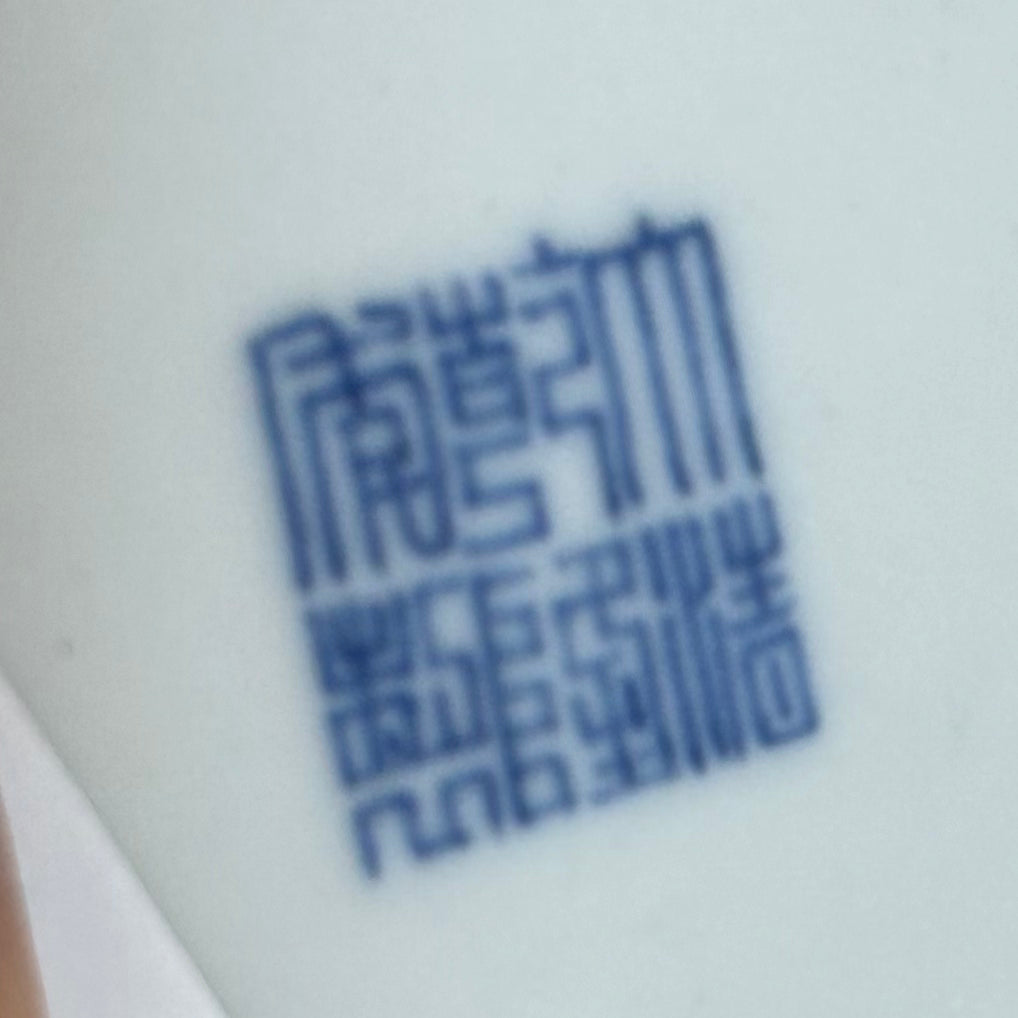
The base bears a six-character blue seal script reign mark 大清乾隆年製 (Dà Qīng Qiánlóng Nián Zhì — "Made in the Qianlong reign period of the Great Qing dynasty") within a double-bordered rectangular cartouche — an apocryphal mark applied in homage to the imperial period this piece so carefully evokes.
- Form: Globular bottle vase, tall cylindrical neck, flared mouth rim, short foot ring
- Handles: Applied beast-head lug handles at neck juncture, unglazed grey-brown biscuit
- Decoration: Allover famille rose polychrome enamel — interlocking lotus scroll with peony medallions to body; ruyi-cloud collar and lotus petal border to shoulder; lotus flower panel to neck; gilt scroll to rim; architectural diaper to foot
- Mark: Six-character blue seal script reign mark 大清乾隆年製 in double-bordered rectangular cartouche — apocryphal Qianlong mark consistent with late Qing–Republic period production
- Period: Late Qing–Republic period, c. 1880s–1940s
- Dimensions: ~10″H × 6″W (25.4 × 15.2 cm)
- Condition: Sound and stable; enamel decoration appears intact and strong; foot ring shows age-appropriate wear. Please see photos for details.
26C*GL