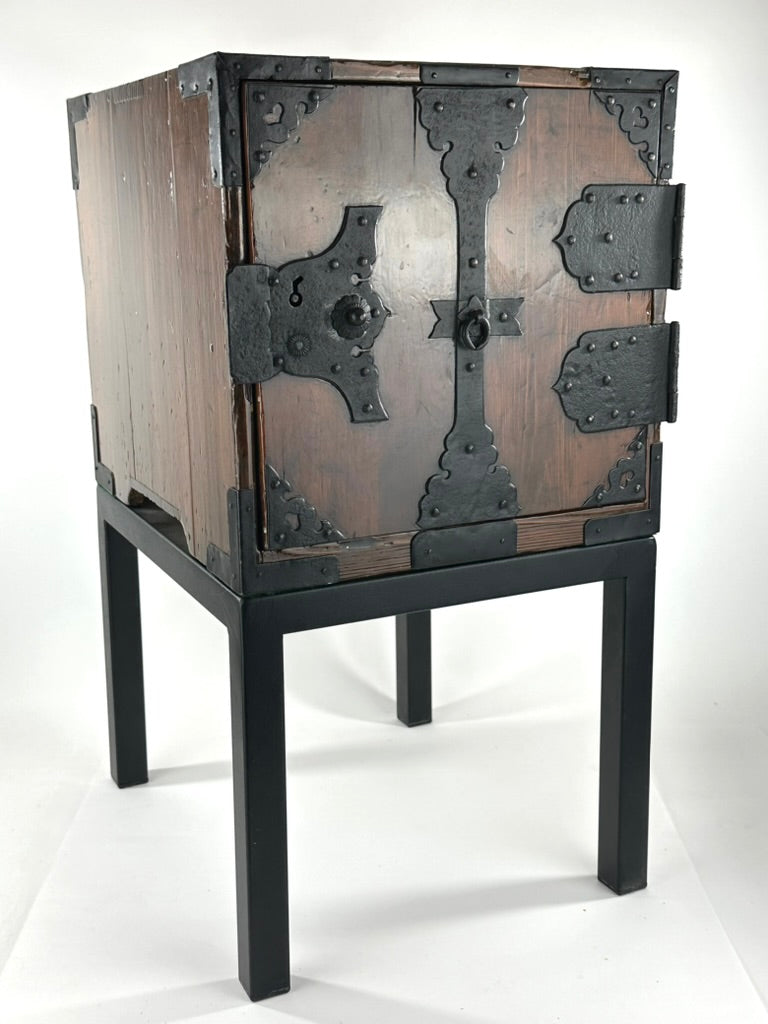


Antique Japanese Funadansu Ship Chest Sugi Iron Hardware Edo Period Custom Stand c1840 21"H
Antique Japanese Funadansu Ship Chest Sugi Iron Hardware Edo Period Custom Stand c1840 21"H
Couldn't load pickup availability
Japanese funadansu (船箪笥) ship's chest, sugi cedar with heavy iron hardware, double-door front with interior drawers, on custom iron stand, late Edo period, c. 1840s
Japan; late Edo period, c. 1840s; sugi (Japanese cedar) throughout; iron hardware
A compact and powerfully constructed funadansu (船箪笥) — the iron-mounted ship's chest developed by Japanese merchant mariners of the Edo period to secure valuables and documents aboard vessels. Built entirely of sugi (杉, Japanese cedar) with heavy forged iron hardware throughout, this example presents the characteristic single-door format with three interior drawers. The door front carries an elaborate iron face plate centered on a chrysanthemum (kiku) boss with key slot, flanked by a vertical locking bar with ring pull and shaped escutcheon — the ironwork cut and shaped in the bold, functional aesthetic of Edo-period maritime hardware. Large shaped corner plates reinforce every exterior edge, their profiles decoratively scalloped. Additional iron banding runs horizontally across the case. The top carries an iron bail handle for portage — a defining feature of the funadansu form, designed to allow the chest to be quickly moved or lashed down in rough seas. Opening the door reveals three sugi drawers fitted with kakute (角手, square ring) pulls on the upper two and a large circular lock plate with kakute pulls on the bottom drawer — the interior construction clean and well-fitted. The sugi throughout has developed a warm amber-honey patina consistent with approximately 180 years of age and use. The lock mechanism is intact but does not hold the latch — a minor mechanical issue easily addressed. Presented on a custom-fabricated iron tube stand that elevates the piece to table height and suits its industrial character well. No maker's marks.
The funadansu emerged as a distinct furniture type during the Edo period, when Japan's coastal merchant trade required portable, secure, and above all robust storage. Unlike household tansu — which prioritized decorative woods and refined hardware — funadansu were built for survival: the iron hardware was designed to act as ballast and fireproofing, and the chests were built to float if a vessel went down. The all-sugi construction of this example, rather than the keyaki-faced versions associated with wealthier captains, marks it as a practical working chest of the merchant class — uncompromised in its hardware but honest in its materials.
This piece has been respectfully restored (not refinished) in-house in the manner that Shogun's Gallery has been caring for Japanese treasures for over 45 years.
- Form: Funadansu (船箪笥) — Japanese ship's chest, single-door with three interior drawers
- Wood: Sugi (杉, Japanese cedar) throughout, interior and exterior
- Hardware: Forged iron — shaped face plate with kiku boss, locking bar, kakute drawer pulls, corner plates, bail handle
- Period: Late Edo, c. 1840s
- Dimensions: 11.5" W × 11.5" D × 11.25" H (29 × 29 × 29 cm); 21.25" H overall with stand
- Stand: Custom fabricated iron tube stand, included
- Lock: Intact; latch does not hold
- Condition: Minor repairs noted. Please see photos for details.