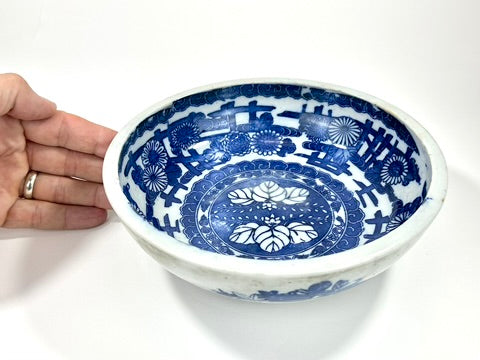


Antique Japanese Imari Sometsuke Blue White Porcelain Bowl Kiku Chrysanthemum 19th 7.5"W
Antique Japanese Imari Sometsuke Blue White Porcelain Bowl Kiku Chrysanthemum 19th 7.5"W
Couldn't load pickup availability
Japanese Imari blue and white porcelain bowl, kiku chrysanthemum and geometric fret interior with kasumon leaf medallion, exterior floral sprigs, 19th century
Japan, Arita; 19th century, mid-to-late Edo period, c. 1850s
A substantial Imari sometsuke (伊万里染付) bowl painted in deep, confident cobalt blue on white, the interior organized in three concentric zones. The central roundel encloses a kasumon-style medallion of overlapping rounded leaves above a small blossom — a family-crest derived motif that appears frequently on domestic Imari wares of the Edo period as an auspicious decorative device. A ruyi cloud-scroll border ring frames the medallion and transitions into the wide central field, where alternating kiku (菊, chrysanthemum) heads and bold geometric fret lattice panels are set against a cloud ground, filling the interior with the dense, layered quality characteristic of mid-nineteenth-century Arita production. A narrow cloud-scroll band closes the composition at the rim. The exterior carries scattered floral sprigs in the same rich cobalt, casually painted in the manner typical of domestic-market wares. The unglazed ring foot shows iron-brown kiln grit and natural age discoloration consistent with Edo-period Imari production. Base unmarked — standard for domestic-market pieces of this type and period.
Imari sometsuke (blue and white Imari) represents the core production of the Arita kilns across the Edo and Meiji periods — wheel-thrown, hand-painted in underglaze cobalt, and fired in the climbing kilns of Hizen Province. Bowls of this scale and decorative density were produced for household use, the kiku and geometric fret vocabulary drawing on a long tradition of auspicious motifs in Japanese ceramic decoration. The kiku (chrysanthemum) carries associations with longevity and autumn beauty, while the interlocking fret pattern derives ultimately from Chinese textile and architectural ornament, absorbed fully into the Arita decorative vocabulary by the mid-Edo period.
- Ware: Imari sometsuke (伊万里染付) blue and white porcelain
- Form: Footed bowl
- Decoration: Kiku chrysanthemum and geometric fret lattice interior with kasumon leaf medallion; exterior floral sprigs
- Period: Mid-to-late Edo, c. 1850s
- Dimensions: 7.5"W × 2.5"H (19 cm × 6.4 cm)
- Condition: The bowl is sound with no visible cracks or repairs. The foot rim shows age-appropriate kiln grit and discoloration. Please see photos for details.