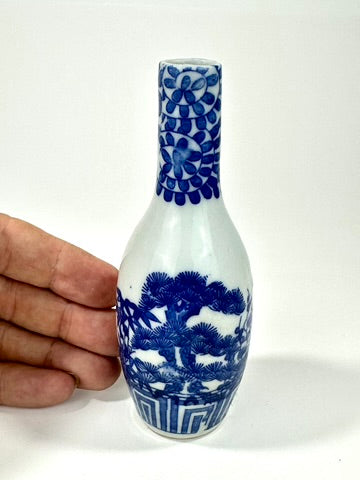


Antique Japanese Imari Blue White Porcelain Butsugu Tokkuri Altar Vase Pine 19thC 5"H
Antique Japanese Imari Blue White Porcelain Butsugu Tokkuri Altar Vase Pine 19thC 5"H
Couldn't load pickup availability
Japanese Imari blue and white porcelain tokkuri-form altar offering vessel (butsugu), pine landscape with meander border and scale-pattern neck, 19th century
Japan, Arita; 19th century, Edo to early Meiji period
A slender tokkuri-form bottle vase in Imari sometsuke (伊万里染付) blue and white porcelain, most likely produced as butsugu (仏具) — a Buddhist altar implement — for use on a household butsudan (仏壇) ancestral memorial altar. The form, scale, and decoration are all consistent with this use: small offering tokkuri were placed in pairs on butsudan shelves as vessels for water or sake presented to ancestral spirits, flanking a central incense burner or ihai memorial tablet. The pine landscape decoration reinforces this reading — matsu (松, pine) carries deep associations with longevity, endurance, and ancestral veneration in Japanese visual culture, making it a natural choice for objects intended for memorial use.
The elongated body and narrow neck are characteristic of Arita tokkuri production. The body carries a freely painted pine landscape in rich cobalt — a gnarled matsu tree with characteristic fan-shaped needle clusters dominates the composition, with rocks and an architectural element or garden fence at the lower register. The shoulder is defined by a meander or key-fret border band. The neck is densely decorated with an overlapping uroko (鱗, scale) pattern in cobalt, giving the upper portion a textile-like quality that contrasts effectively with the open landscape below. The cobalt throughout is rich and confident, showing the slight pooling and variation characteristic of hand-painting rather than transfer work. Minor kiln imperfection on one side — a firing characteristic inherent to the piece. The foot ring is unglazed with kiln grit consistent with 19th century Arita production. Base unmarked. A matching companion piece would have originally been paired with this vessel on the altar shelf.
Imari sometsuke (blue and white Imari) represents the core production of the Arita kilns across the Edo and Meiji periods — wheel-thrown, hand-painted, and fired in the climbing kilns of Hizen Province. The butsudan (仏壇), present in the majority of Japanese Buddhist households, required a standardized set of altar implements including candle holders, incense burners, flower vases, and offering vessels — all typically produced in matched sets. Blue and white sometsuke tokkuri of this type were among the most widely produced butsugu of the Edo period.
- Ware: Imari sometsuke (伊万里染付) blue and white porcelain
- Form: Tokkuri-form altar offering vessel (butsugu, 仏具)
- Decoration: Pine landscape with meander border (body); uroko scale pattern (neck)
- Period: 19th century, Edo to early Meiji
- Dimensions: 1.5" W × 5" H (4 × 13 cm)
- Condition: Minor kiln imperfection on one side. Please see photos for details.