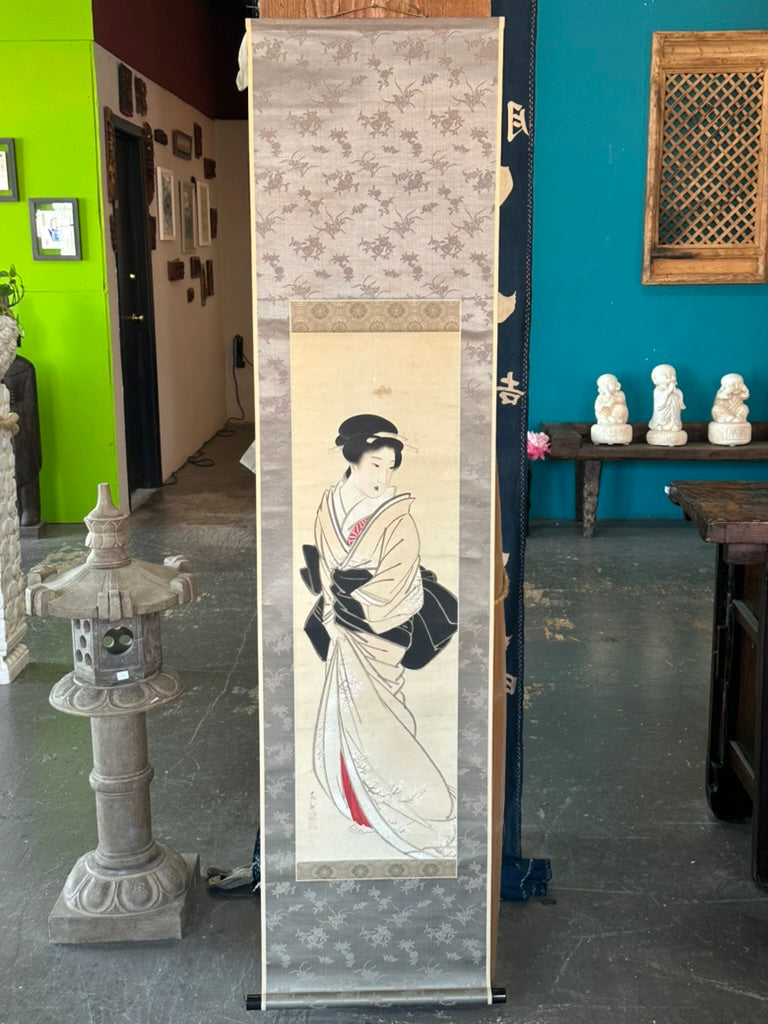


Antique Japanese Kakejiku Bijin-ga Beauty Spider Web Kimono Meiji Taisho Scroll 72"L
Antique Japanese Kakejiku Bijin-ga Beauty Spider Web Kimono Meiji Taisho Scroll 72"L
Couldn't load pickup availability
Japanese kakejiku hanging scroll, ink and color on paper, standing bijin in white spider-web patterned kimono with black obi — 美人画 (Bijin-ga), with original storage box, Meiji to Taishō period
Japan; Meiji to Taishō period, c. 1890s–1920s; signed with two red seals; original wooden storage box inscribed 真龍美人畫
A refined and distinctly unusual bijin-ga (美人画, beauty painting) depicting a standing woman in formal dress, rendered in ink and soft mineral color on paper. She wears a trailing white kimono decorated throughout with fine spider web (蜘蛛の巣, kumo no su) patterns rendered in delicate grey lines against the white ground — an unconventional and sophisticated textile motif that immediately distinguishes this figure from routine beauty painting. The spider web in Japanese decorative tradition carries associations with autumn, impermanence, and the quietly uncanny; its appearance here as the primary kimono decoration gives the figure an air of elegance touched with mystery. A deep red under-robe lining is visible at the trailing hem, the contrast between the white outer kimono and the crimson lining intensifying the compositional drama. A deep black obi completes the formal dress. Her shimada coiffure is set with kanzashi, and her face is painted in the elongated, refined manner of the Kyoto nihonga bijin tradition — high forehead, narrow downcast eyes, lips barely parted, the expression one of composed and self-contained elegance. The figure is presented against a plain warm ground, the entire composition built around the interplay of the delicate web-patterned textile, the bold graphic note of the black obi, and the crimson hem. Signed in cursive script lower left with two red seals. The mounting is a sophisticated grey silk woven with peony and botanical motifs — a formal, high-quality tokonoma mounting in excellent harmony with the subject. Comes with its original wooden storage box inscribed 真龍美人畫 (Shinryū Bijin-ga — Beauty Painting).
The bijin-ga tradition — paintings of beautiful women — runs continuously through Japanese art from the Heian period through ukiyo-e and into the Meiji and Taishō nihonga revival. By the late Meiji period, painters working in the nihonga style brought new technical refinement to the bijin subject, combining traditional ink and gofun (白粉, shell white) with careful observation of contemporary feminine dress and bearing. The spider web motif (kumo no su-mon) appears in Japanese textiles and decorative arts as an autumn symbol, associated in poetry and visual culture with the fragile geometry of the natural world and the passage of time — its use as the primary decoration of a bijin's kimono is an aesthetic choice of unusual intelligence and confidence.
The imperfections accumulated over more than a century of this scroll's life — the gentle toning, the subtle creasing — are the quiet evidence of its authenticity and age, the wabi-sabi texture that separates a scroll with genuine history from one without. Please see photos for full condition details.
- Format: Kakejiku (掛軸) hanging scroll with original kiri wood storage box
- Subject: 美人画 (Bijin-ga) — standing beauty in white spider web-patterned kimono
- Medium: Ink, mineral color, and gofun on paper; grey silk mounting with floral pattern
- Artist: Signed in cursive script with two red seals (identity unconfirmed)
- Box inscription: 真龍美人畫 (Shinryū Bijin-ga)
- Period: Meiji to Taishō, c. 1890s–1920s
- Dimensions (art): 12" W × 39" H (30 × 99 cm); overall: 17" W × 72" H (43 × 183 cm)
- Condition: Imperfections as shown in photos. Please see photos for details.