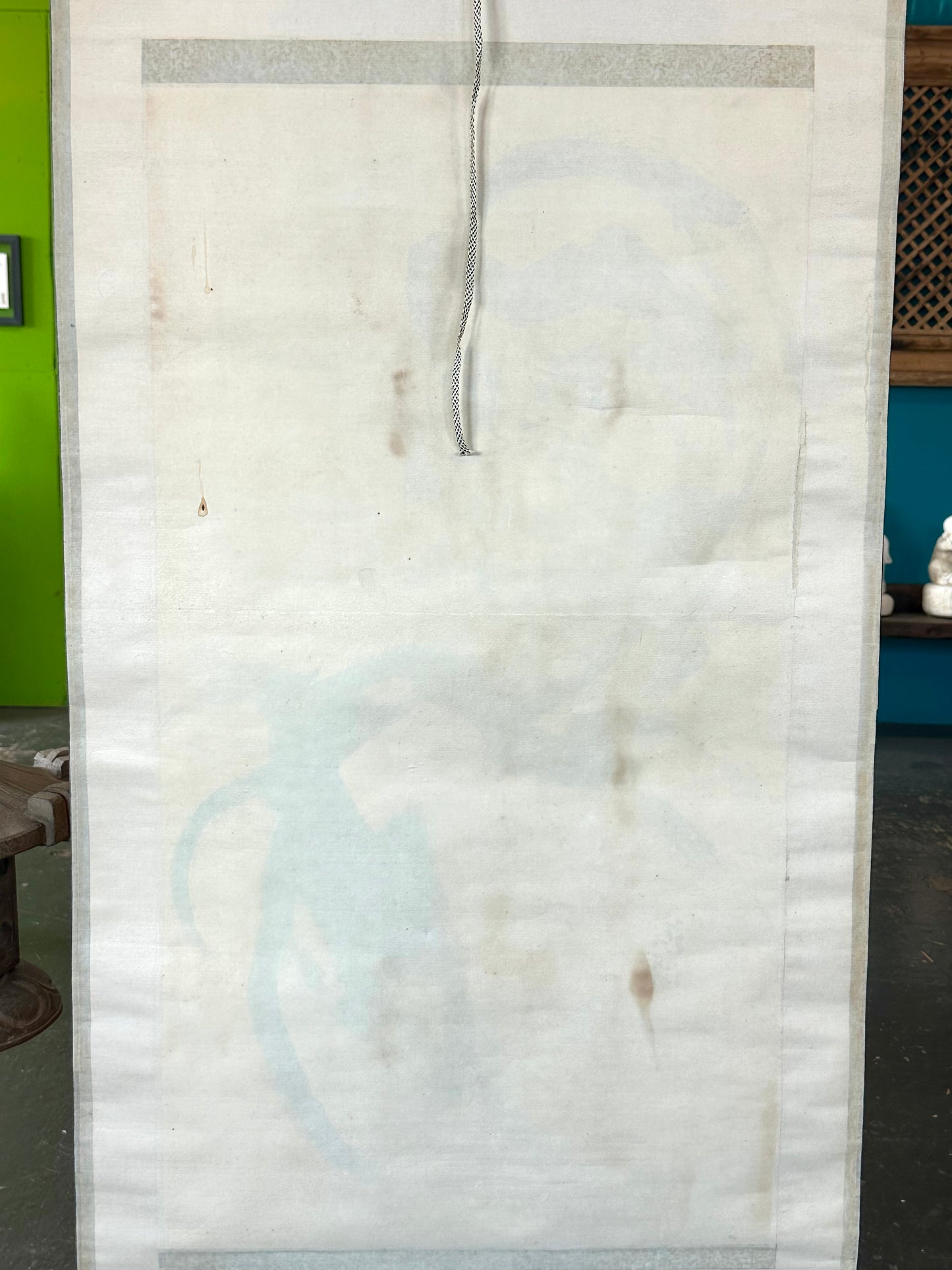


Antique Japanese Kakejiku Hanging Scroll Daruma Bodhidharma Zenga Ink Painting 61"L
Antique Japanese Kakejiku Hanging Scroll Daruma Bodhidharma Zenga Ink Painting 61"L
Couldn't load pickup availability
Japanese kakejiku hanging scroll, sumi ink on paper, bold zenga-style portrait of Daruma (Bodhidharma), signed and sealed, Taishō to early Shōwa period
Japan; Taishō to early Shōwa period, c. 1910s–1930s
A commanding zenga-style portrait of Daruma (達磨, Bodhidharma) executed in sumi ink on paper with broad, decisive brushwork. The patriarch's face dominates the upper field — heavy brow rendered in a single sweeping stroke, the characteristic fierce eyes achieved with minimal marks of great expressive force, the beard and whiskers suggested in wet, pooling ink. The body and robes below are reduced to a few bold, gestural strokes that spiral and extend into the lower composition, conveying both mass and movement without detail. The composition is characteristically Zen in its economy: nothing unnecessary is present, and the white ground functions as positive space as much as the ink itself. Signed 珑澤 in brush lower left with one red seal below.
The subject is notable in sharing a signature with a companion tiger scroll from the same hand — the two likely formed part of the same collection or were acquired together. Whether this represents a Zen monk-painter, a secular artist working in the zenga tradition, or a professional scroll painter, the brushwork quality is assured and the Daruma image powerful.
Daruma (達磨) was among the most painted subjects in Japanese ink art. The Indian-born Buddhist patriarch credited with transmitting Chan (Zen) Buddhism to China in the 5th or 6th century, he is celebrated for his legendary nine years of wall-gazing meditation at Shaolin Temple. In Japan, Daruma images are regarded as symbols of perseverance, determination, and the overcoming of obstacles — making zenga-style Daruma portraits among the most spiritually charged objects in the Japanese decorative tradition. The subject was practiced by Zen monks and secular painters alike, from the Edo period through the early modern era.
The mounting is plain linen with a dark brocade accent band — simple and appropriate to the Zen subject. Condition issues that are now part of the wabisabi appeal and story of this scroll include several repairs, three damage holes visible in the painting field, foxing, and discoloration as shown in the photos. A scroll that rewards the viewer willing to look past condition — the brushwork is genuinely strong.
- Format: Kakejiku (掛軸) hanging scroll
- Subject: Daruma (達磨, Bodhidharma) — zenga-style portrait
- Medium: Sumi ink on paper; plain linen mounting with dark brocade band
- Artist: Signed 珑澤 with red seal (same signature as companion tiger scroll; identity unconfirmed)
- Period: Taishō to early Shōwa, c. 1910s–1930s
- Dimensions (art): 20.25" W × 37.5" H (51 × 95 cm); overall: 26.5" W × 61.5" H (67 × 156 cm)
- Condition: Several repaired holes in painting field; foxing and discoloration present. Please see photos for details.