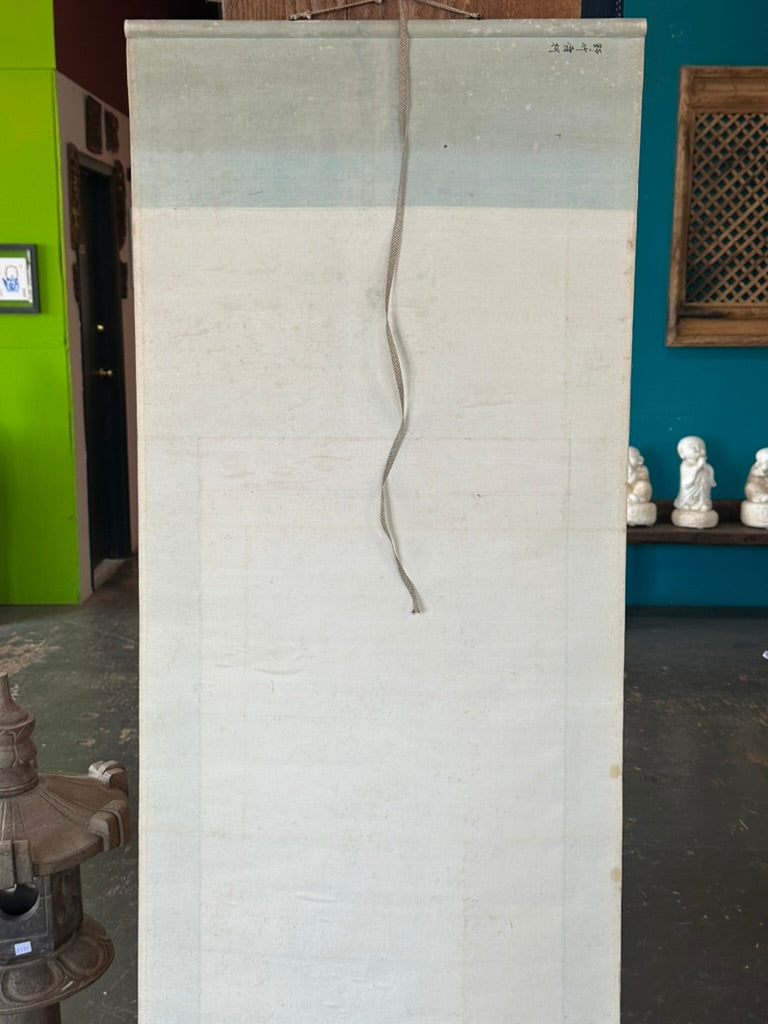


Antique Japanese c1912 Kakejiku Hanging Scroll Wild Bamboo Frost Branch Sumi Ink Signed 76"L
Antique Japanese c1912 Kakejiku Hanging Scroll Wild Bamboo Frost Branch Sumi Ink Signed 76"L
Couldn't load pickup availability
Japanese kakejiku hanging scroll, sumi ink on paper, wild bamboo and frost-covered branch on rocky ground — 野竹霜柯 (Nochiku Sōka), with original storage tube, Meiji to Taishō period
Japan; Meiji to Taishō period, c. 1912; signed 宝玄 (Hōgen), dated 壬子五月 (Fifth month, Mizunoe-Ne year)
A refined literati-style ink painting depicting a leafless winter tree rising from a craggy rock, with sparse bamboo clinging at the base — the classical subject of 野竹霜柯 (Nochiku Sōka, "wild bamboo and frost-covered branch") executed in confident, unhurried sumi brushwork. The bare tree is rendered in dry, precise strokes that articulate each branching with botanical clarity; the rock below is built up in layered wet washes with darker ink defining the crevices and planes. Small ground-cover plants scatter across the base. The composition occupies the lower two-thirds of the painting field, leaving the upper portion as open space — a classic literati device that allows the eye to breathe and the imagination to extend the scene. The inscription at upper left reads 野竹霜柯 / 壬子五月写 (Painted in the fifth month of Mizunoe-Ne year) / 宝玄 with one red seal. The scroll is fitted with handsome dark rosewood jikusaki scroll ends, labeled 野竹霜柯 in brush.
The foxing, toning, and age marks that have accumulated over more than a century of the scroll's life are not flaws to apologize for — they are the physical record of its history, the wabi-sabi patina that no new work can replicate. A scroll this age that has survived intact, with its original fittings, carries a richer story than any pristine reproduction. These marks of time are part of what the viewer can draw in and appeciate.
The subject draws on the literati (bunjin) painting tradition, in which the "three friends of winter" — pine, bamboo, and plum — and adjacent subjects like the frost-covered bare branch symbolize perseverance, integrity, and the cultivation of character through adversity. The bamboo bends but does not break; the bare tree endures the frost without leaves; the scholar who keeps these images on his wall aligns himself with these virtues. The 壬子 cyclical year corresponds most likely to 1912, placing this scroll at the transition between Meiji and Taishō — a moment of significant cultural shift in Japan when the literati painting tradition was being both continued and reconsidered.
- Format: Kakejiku (掛軸) hanging scroll
- Subject: 野竹霜柯 (Nochiku Sōka — Wild Bamboo and Frost-Covered Branch)
- Medium: Sumi ink on paper; silk mounting with crackle-pattern ground; dark rosewood jikusaki
- Artist: 宝玄 (Hōgen); dated 壬子五月写 (Fifth month, 1912)
- Period: Meiji to Taishō, c. 1912
- Dimensions (art): 16.25" W × 44" H (41 × 112 cm); overall: 22" W × 76" H (56 × 193 cm)
- Condition: Foxing and toning present throughout — the honest patina of age on a century-old work. Please see photos for details.