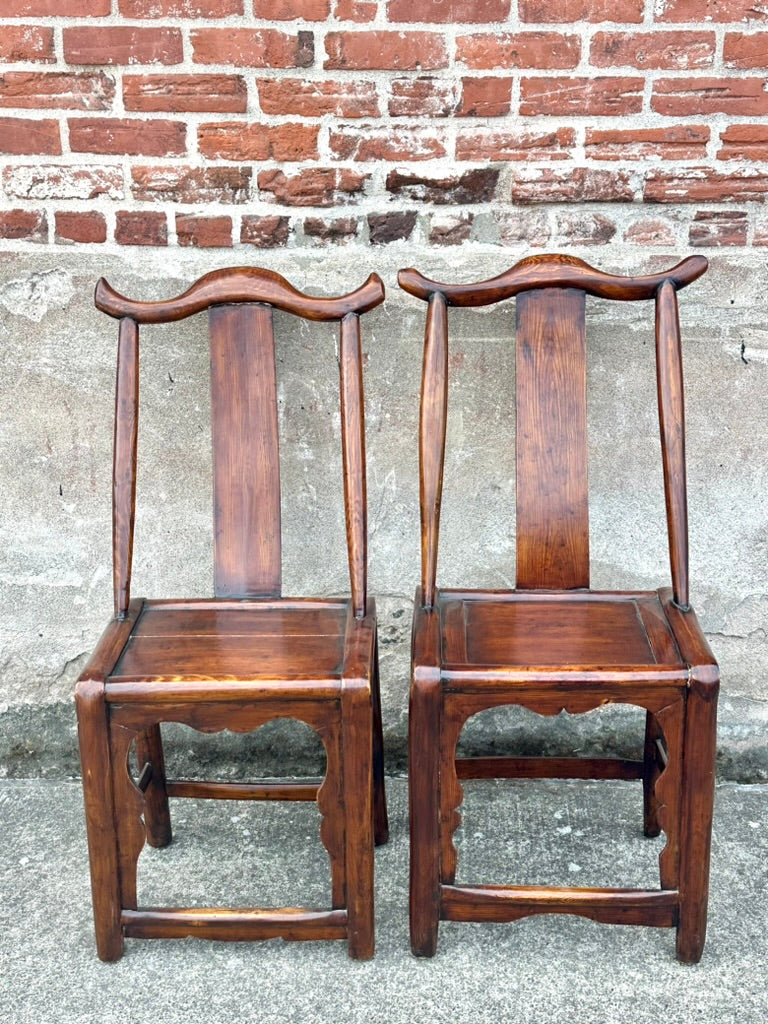


SAVE 40%! Antique Chinese Elm Yoke Back Official's Hat Chair Guanmaoyi Late Qing Dynasty 38"H LS#139
SAVE 40%! Antique Chinese Elm Yoke Back Official's Hat Chair Guanmaoyi Late Qing Dynasty 38"H LS#139
Couldn't load pickup availability
Chinese elm wood yoke-back official's hat chair (guanmaoyi), carved ruyi-cloud apron, solid plank seat, late Qing dynasty
Two available and two show in photos. Sold individually.
China; late Qing dynasty, 19th–early 20th century
A well-proportioned Chinese elm (榆木, yúmù) yoke-back side chair in the classic guanmaoyi (官帽椅) form — named for its resemblance to the winged caps worn by imperial officials. The gracefully curved crest rail sweeps upward at each end into characteristic upswept tips, supported by slightly splayed back posts that give the chair its characteristic open, elegant profile. A wide flat back splat rises from the seat frame to meet the crest rail, providing comfortable lumbar support in the manner typical of late Qing regional production. The solid elm plank seat is set into a substantial frame with a characteristic floating-panel construction. The front and side aprons are carved with ruyi cloud-scroll spandrels — an auspicious motif associated with good fortune and longevity — adding decorative interest to what is otherwise a restrained and architecturally refined form. Four straight square-section legs are joined by plain stretchers on three sides; the rear stretcher is raised slightly from the floor in the standard manner. Throughout, the construction relies on traditional mortise-and-tenon joinery without the use of nails or adhesives.
The guanmaoyi is one of the most enduring forms in Chinese furniture, with roots in the Song dynasty and continuous production through the Ming and Qing periods. Regional elm examples from the late Qing period — particularly from Shanxi and Shaanxi provinces, where elm was the dominant hardwood — represent the form at its most robust and unpretentious: honest construction, warm grain, and a patina that deepens over generations of use. Elm (yumu) was prized for both its workability and the dramatic figuring its grain produces, visible here across the seat panel and back splat.
- Form: Yoke-back side chair (guanmaoyi, 官帽椅)
- Material: Elm (榆木, yúmù)
- Construction: Mortise-and-tenon joinery; floating panel seat; carved ruyi-cloud apron spandrels
- Period: Late Qing dynasty, 19th–early 20th century
- Dimensions:
- Condition: Structurally a bit weak at the joints, should be considered mainly decorative for just occasional use. A hairline crack is visible at the junction of the crest rail and one back post, consistent with the age and movement of the wood. The surface shows an honest patina of age and use throughout. Please see photos for details.