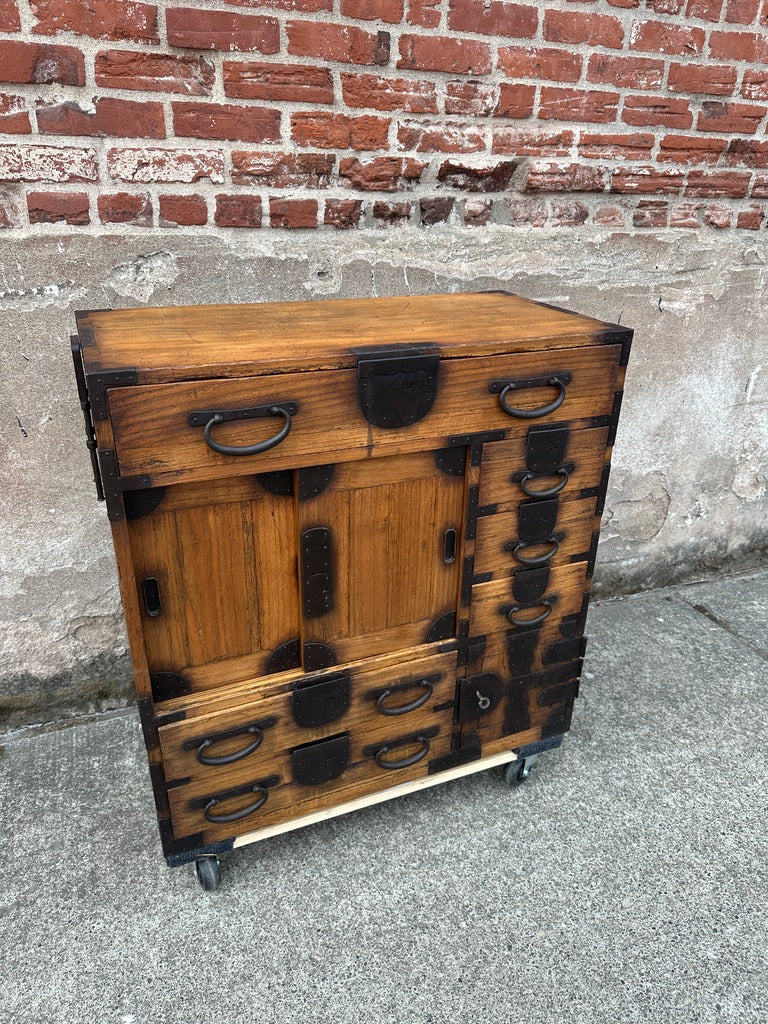


Antique Japanese Chobadansu Merchant Chest Sugi Iron Hardware Dated Meiji 1880
Antique Japanese Chobadansu Merchant Chest Sugi Iron Hardware Dated Meiji 1880
Couldn't load pickup availability
Japanese chōbadansu (帳場箪笥) merchant's account chest, sugi cedar with hand-forged iron Warabite and Gumpai hardware, inscribed and dated Meiji 13 (1880)
Japan; Meiji period, dated September 1880 (明治十三年九月吉日)
A Japanese chōbadansu (帳場箪笥) — the specialized merchant's account and document chest — of exceptional historical documentation, the back panel bearing a large brushed ink inscription that dates and identifies the piece with the precision rarely encountered in antique Japanese furniture. The inscription reads 明治十三庚辰年九月吉日 (Meiji jūsan kōshin-nen kugatsu kichijitsu): "an auspicious day in September, the thirteenth year of Meiji, year of the Metal Dragon" — corresponding to September 1880. Beside the date inscription, a personal name — most likely that of the original owner or the craftsman who commissioned the piece — is written in flowing brush script, connecting this chest to a specific individual in the merchant world of early Meiji Japan.
The front layout follows the standard chōbadansu configuration developed for the commercial interior: a full-width shallow drawer at the top for immediate-access documents; a large two-panel sliding door section at center-left secured by a central iron hasp and lock plate, providing enclosed storage for account books, cash boxes, and valuables; a column of four small drawers at the right for compartmentalized storage of seals, brushes, and smaller implements; and two full-width drawers across the lower section for bulkier storage. The asymmetric arrangement of open and enclosed storage zones is characteristic of the chōbadansu form, which was designed to serve simultaneously as working desk surface, document storage, and secure repository within the Japanese merchant's shop or counting house.
The hardware throughout is hand-forged iron of the quality expected in dated Meiji commercial production: Warabite (蕨手) bracken-fern bail handles on all drawers, large Gumpai (軍配) military fan-form lock plates on the sliding door panels and central hasp, and flat strap reinforcements with square-head rivets at all case corners and structural junctions. The wood is sugi (杉, Japanese cedar) with areas of dramatic hi-ire surface treatment — a deliberate flame-scorching technique that creates the characteristic deep brown-black patina marks against the warm cedar ground visible across the case. This treatment, which darkens the softer grain channels while leaving the harder grain ridges lighter, is not damage but a period finish convention that gives the piece its distinctive visual character and provides a degree of insect and moisture resistance.
This piece has been respectfully restored (not refinished) in-house in the manner that Shogun's Gallery has been caring for Japanese treasures for over 45 years.
- Form: Chōbadansu (帳場箪笥) merchant's account chest
- Construction: Sugi (杉) cedar with hi-ire flame treatment; hand-forged iron Warabite (蕨手) bail handles; Gumpai (軍配) lock plates; flat strap corner and edge reinforcements with square-head rivets; sliding fusuma door panels with center lock hasp
- Hardware: Hand-forged iron throughout — Warabite handles, Gumpai lock plates, flat strap reinforcements
- Inscription: Back panel brushed in ink: 明治十三庚辰年九月吉日 (Meiji jūsan kōshin-nen kugatsu kichijitsu, "an auspicious day in September, Meiji 13, year of the Metal Dragon," = September 1880); 孝多治郎兵衛 (Kōta Jirōbei), the name of the original owner, a merchant of the early Meiji period.
- Period: Meiji, dated September 1880
- Dimensions: Approximately 36"W × 36"H × 16"D (dimensions TBD)
- Weight:
- Condition: Sound and stable. The surface shows the characteristic age-appropriate patina consistent with 145 years of use. Please see photos for details.