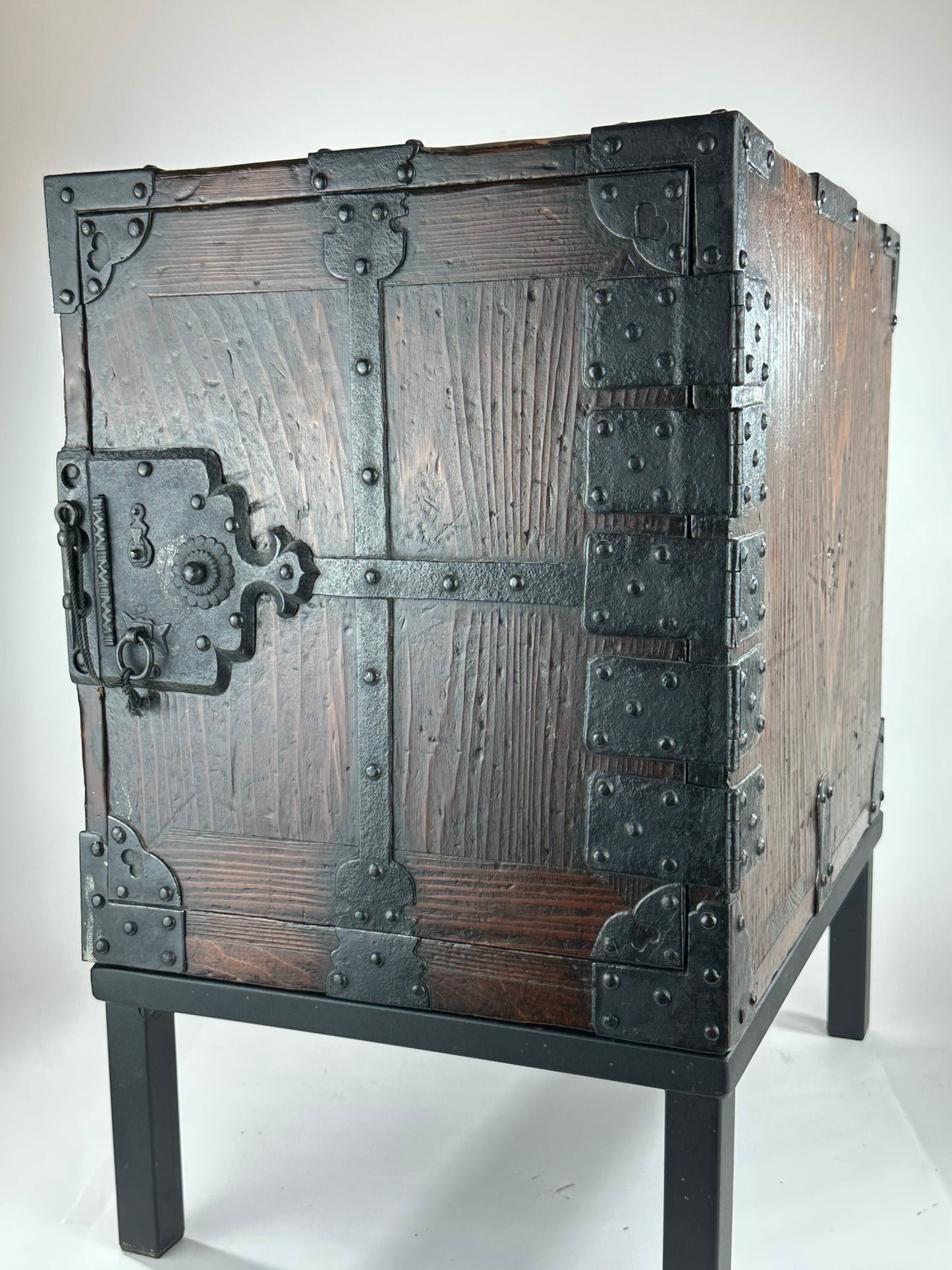


ntique Japanese Funadansu Ship Chest Sugi Kiri Iron Hardware Edo Period Custom Stand c1840's
ntique Japanese Funadansu Ship Chest Sugi Kiri Iron Hardware Edo Period Custom Stand c1840's
Couldn't load pickup availability
Japanese funadansu (船箪笥) ship's chest, sugi cedar face and case with kiri paulownia interior, hand-forged burnt lacquer iron hardware, seven-compartment interior, on custom iron stand, early Edo period, c. 1800
Japan; early to mid-Edo period, c. 1800; sugi (Japanese cedar) face and case, kiri (paulownia) drawer interiors; hand-forged iron hardware with burnt lacquer (yakitsuke) finish
A substantial and well-appointed funadansu (船箪笥) of the type associated with prosperous Edo-period merchant captains — larger in scale and considerably more complex in organization than the typical small ship's chest, with seven interior compartments and an impressive array of hand-forged iron hardware throughout. The exterior case is sugi (杉, Japanese cedar), its surface carrying the deeply patinated, scratched, and burnished character of more than two centuries of working life. Iron hardware covers the case comprehensively: horizontal banding straps, shaped and scrolled corner plates, a large rectangular lock plate on the front face with chrysanthemum (kiku) boss and key slot, a vertical locking bar with ring pull, additional kiku-boss hardware on the side face, and a flat iron bar bail handle at the top — all hand-forged with hammer texture intact and finished in burnt lacquer (yakitsuke) that has mellowed to a warm dark patina. The double doors open to reveal a seven-compartment interior of considerable sophistication: two full-width drawers at the top fitted with ring (warabite) pulls, and a lower section divided between a large lockable compartment at left — with its own iron keyhole plate and kiku-boss pull — and three stacked small drawers at right. The drawer interiors throughout are kiri (桐, paulownia) — the traditional Japanese choice for fine interior fittings, valued for its resistance to moisture and insects. Lock mechanism intact; latch does not hold. Presented on a custom-fabricated iron tube stand. No maker's marks.
The funadansu (船箪笥) emerged as a distinct furniture type during the Edo period, when Japan's extensive coastal merchant trade required portable, fireproof, and above all indestructible storage for money, documents, and valuables. The iron hardware served multiple purposes simultaneously — structural reinforcement, fireproofing, ballast, and if necessary the means by which a chest might be recovered floating after a shipwreck. The complexity of the interior organization in this example — seven compartments including a separately lockable inner safe — and the extent of the ironwork coverage indicate a chest made for a merchant of some standing, likely a captain or senior ship's officer rather than ordinary crew. The combination of sugi exterior with kiri interior fittings is characteristic of quality Edo-period production.
This piece has been respectfully restored (not refinished) in-house in the manner that Shogun's Gallery has been caring for Japanese treasures for over 45 years.
- Form: Funadansu (船箪笥) — Japanese ship's chest, double-door with seven interior compartments
- Wood: Sugi (杉, Japanese cedar) face and case; kiri (桐, paulownia) drawer interiors
- Hardware: Hand-forged iron with burnt lacquer (yakitsuke) finish — lock plate with kiku boss, vertical locking bar, warabite ring pulls, corner plates, bail handle
- Period: Late Edo, c. 1840's
- Dimensions: 13.25" W × 17.5" D × 15.25" H (34 × 44 × 39 cm); 21.25" H overall with stand
- Stand: Custom fabricated iron tube stand, included
- Lock: Intact; latch does not hold
- Condition: Minimal minor repairs. Please see photos for details.