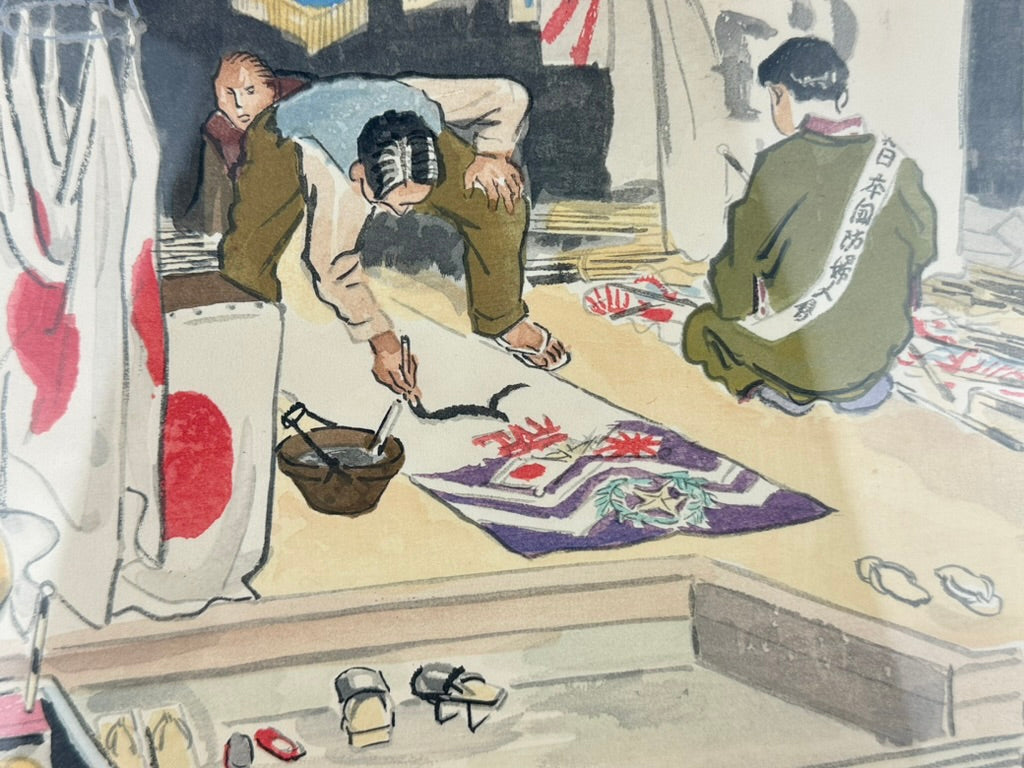


Original Japanese Woodblock Print Wada Sanzo "Flag Merchant" 1940 Showa Series LS#096
Original Japanese Woodblock Print Wada Sanzo "Flag Merchant" 1940 Showa Series LS#096
Couldn't load pickup availability
Sanzo Wada (1883–1967)
Sketches of Occupations in the Showa Era
(昭和職業絵尽し, Shōwa Shokugyō E-zukushi)
Wada Sanzō — 昭和職業絵盡し 旗屋 (Shōwa Shokugyō E-zukushi: Hataya) — 1940
One of the most historically charged subjects in Wada Sanzō's landmark series documenting the occupations of Showa-era Japan, the Hataya — flag merchant — captures the interior of a wartime flag shop at the height of Japan's military mobilization. Two workers occupy the raised shop floor: one bent low, brush in hand, painting the finishing details on a large rising sun military banner (旭日旗) spread across the tatami; the second seated, working on another commission. The shop is hung from rafters and walls with Hinomaru national flags, military celebration banners, and pennants of various types — the full inventory of a business thriving on wartime patriotic demand. In the foreground, boxes of paper lanterns (chōchin) and geta sandals compete for floor space; an umbrella stand occupies the right corner. The composition is Wada at his most documentary — dense with period-specific detail, rendered in his signature warm, muted palette with confident brushwork translated faithfully into the woodblock medium. As a record of wartime Japanese commercial life, the Hataya print is among the most historically specific and visually rich subjects in the entire E-zukushi series.
The flag shop (旗屋) was a fixture of Japanese commercial streetscapes throughout the militarist period, supplying the constant demand for national flags, military regimental banners, and celebratory decorations for troop send-offs, victories, and national holidays. The rising sun flag being hand-finished in the foreground — the 旭日旗 of the Imperial Japanese military — makes the wartime date of this print unmistakable, giving it both documentary and historical significance that sets it apart from the more timeless craft subjects elsewhere in the series. Wada Sanzō (1883–1967) studied Western-style painting at the Tokyo School of Fine Arts, graduating in 1904, and refined his technique through seven years of study in Europe from 1907 to 1914. Back in Japan he became a central figure in the national art scene, teaching at the Tokyo School of Fine Arts and serving as a member of the Imperial Arts Academy. The Shōwa Shokugyō E-zukushi series, begun in 1938 and published by Nishinomiya Shoin, comprises 48 prewar prints; a postwar continuation of 24 further designs followed from 1954 to 1958. Wada later received the American Motion Picture Academy Award in 1955 for costume design for the film Gates of Hell and the Order of Cultural Merit in 1958. His prints are held in the British Museum, the National Museum of Modern Art Tokyo, and the Fukuoka Art Museum, among others.
- Title: 旗屋 (Hataya — Flag Merchant)
- Series: 昭和職業絵盡し (Shōwa Shokugyō E-zukushi — Sketches of Occupations in the Showa Era)
- Artist: Wada Sanzō (和田三造, 1883–1967)
- Publisher: Nishinomiya Shoin
- Date: 1940
- Edition: Limited edition, 300 impressions
- Format: Polychrome woodblock print (mokuhanga)
- Matted dimensions: 18.5"W × 14.75"H
Condition: Very good. Colors fresh. Margins intact. Signed Sanzō (三造) with two red seals; edition seal present.
A rare and historically compelling impression — the flag shop subject among the most period-specific and collectible prints in the E-zukushi series, its wartime commercial interior an unambiguous document of Japan in 1940.