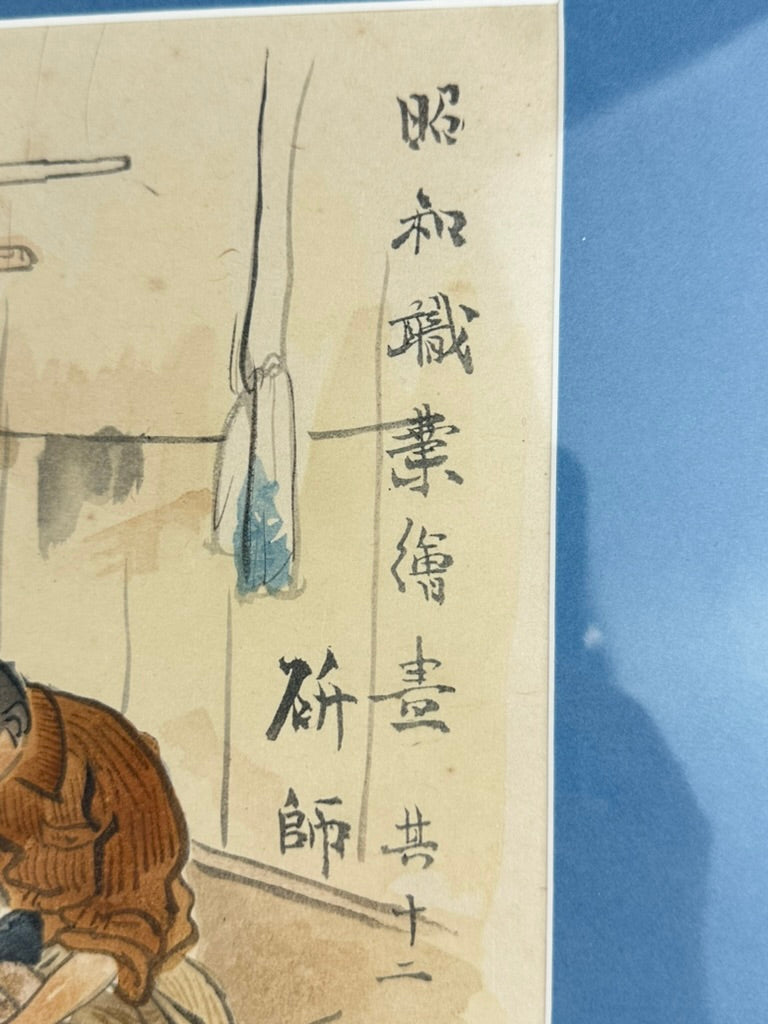


Original Japanese Woodblock Print Wada Sanzo "Sword Polisher" 1939 Series #12 1939 LS#095
Original Japanese Woodblock Print Wada Sanzo "Sword Polisher" 1939 Series #12 1939 LS#095
Couldn't load pickup availability
Sanzo Wada (1883–1967)
Sketches of Occupations in the Showa Era
(昭和職業絵尽し, Shōwa Shokugyō E-zukushi)
Woodblock prints, c. 1938–1942
Wada Sanzō — 昭和職業絵盡し 研師 (Shōwa Shokugyō E-zukushi: Togishi) — c. 1939
A beautifully composed print from Wada Sanzō's landmark series documenting the occupations of Showa-era Japan, this subject — the sword polisher (研師, togishi) — offers an intimate view into one of the most specialized and ancient of Japanese craft traditions. The workshop interior is rendered with Wada's characteristic economy: a master polisher seated cross-legged examines a blade at eye level, assessing the surface with practiced eye, while his apprentice kneels at a whetstone working a second blade with focused concentration. The workshop floor is spread with the tools of the trade — graduated polishing stones (toishi) of various grits, wooden forms, water vessels, and finished and unfinished blades — a spare but complete inventory of the togishi's world. A sword hangs on a rack on the wall behind, the spare workshop interior conveying the discipline and quiet intensity of the craft. Wada's muted warm palette — ochre, grey-brown, deep navy — and his signature watercolor-wash technique give the scene the feeling of a careful observational sketch, entirely in keeping with the documentary spirit of the series.
The togishi occupies a singular position in Japanese sword culture. While the swordsmith (katanakaji) forges the blade, it is the polisher who reveals its true character — drawing out the hamon (temper line), the ji (blade surface), and the overall aesthetic quality through a process of progressive refinement across multiple stone grits that can take weeks for a single blade. The craft dates to the earliest period of Japanese sword-making and remains a registered traditional craft today. Wada Sanzō (1883–1967) studied Western-style painting at the Tokyo School of Fine Arts, graduating in 1904, and refined his technique through seven years of study in Europe from 1907 to 1914. Back in Japan he became a central figure in the national art scene, teaching at the Tokyo School of Fine Arts and serving as a member of the Imperial Arts Academy. The Shōwa Shokugyō E-zukushi series, begun in 1938 and published by Nishinomiya Shoin, comprises 48 prewar prints; a postwar continuation of 24 further designs followed from 1954 to 1958. Wada later received the American Motion Picture Academy Award in 1955 for costume design for the film Gates of Hell and the Order of Cultural Merit in 1958. His prints are held in the British Museum, the National Museum of Modern Art Tokyo, and the Fukuoka Art Museum, among others.
- Title: 研師 (Togishi — Sword Polisher)
- Series: 昭和職業絵盡し (Shōwa Shokugyō E-zukushi — Sketches of Occupations in the Showa Era), No. 12
- Artist: Wada Sanzō (和田三造, 1883–1967)
- Publisher: Nishinomiya Shoin
- Date: c. 1939
- Format: Polychrome woodblock print (mokuhanga)
- Matted: 18.5" x 14.75"H
Condition: Very good. Some toning to paper ground consistent with age. Colors well-preserved. Margins intact. Signed Sanzō (三造) with two red seals lower right; circular collector's seal at lower margin. Matted.
A compelling document of a craft inseparable from Japanese cultural identity — the togishi among the more evocative and collectible subjects in the E-zukushi series.