

Original Kiyochika Woodblock Print Nogi Maresuke Commander Sino Japanese War 1895 LS#202
Original Kiyochika Woodblock Print Nogi Maresuke Commander Sino Japanese War 1895 LS#202
Couldn't load pickup availability
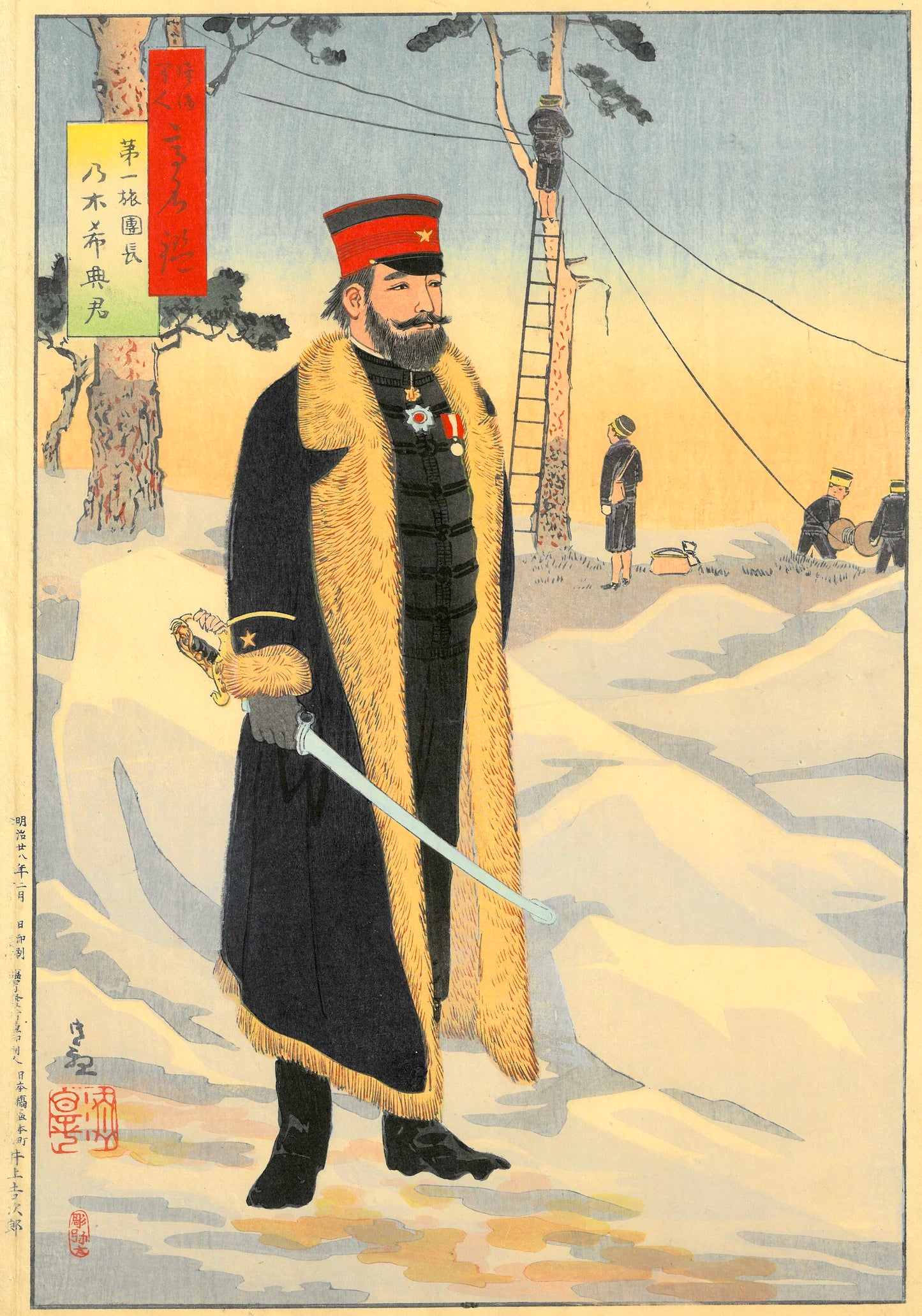
Kobayashi Kiyochika (小林清親) — 第一旅團長 乃木希典君 (Dai-ichi Ryodan-chō Nogi Maresuke-kun) — Meiji 28 (1895)
A commanding and finely printed portrait print by Kobayashi Kiyochika, from his 1895 series documenting heroes of the First Sino-Japanese War. The subject is General Nogi Maresuke (乃木希典, 1849–1912), identified by cartouche as Commander of the First Brigade (第一旅團長) — the role in which he led the assault on Port Arthur in November 1894. Nogi stands in three-quarter view in a snowy winter landscape, wearing a full-length fur-trimmed military overcoat over his dark uniform, a red-starred cap, and medals at his chest; his sword hangs at his side, its blade catching the pale light. Behind him, soldiers climb a telegraph pole amid pine trees against a luminous yellow-gold winter sky — the modern military infrastructure of the new Japan rendered with characteristic quietude. The mood is composed and authoritative rather than martial, reflecting Kiyochika's restraint as a portraitist. Published by Ushikami Sakichiro (牛上左吉次郎), Nihonbashi, Tokyo, February, Meiji 28 (1895). Engraved by Hori Yata (彫弥太).
- Title: 第一旅團長 乃木希典君 (Dai-ichi Ryodan-chō Nogi Maresuke-kun — "Commander of the First Brigade, General Nogi Maresuke")
- Artist: Kobayashi Kiyochika (小林清親, 1847–1915)
- Publisher: Ushikami Sakichiro (牛上左吉次郎), Nihonbashi, Tokyo
- Date: Meiji 28 (1895), February
- Format: Oban — approximately 14" × 9.5" (36 × 24 cm)
Excellent; colors bright and vivid with no fading. No tears or creases. Strong bleed-through on reverse consistent with quality Meiji printing. A particularly well-preserved example.
A portrait of one of the Meiji period's most celebrated and tragic military figures — Nogi would later achieve near-mythic status through his ritual suicide following Emperor Meiji's death in 1912 — captured here at the height of his wartime command by one of the era's foremost printmakers.