

Antique Chinese Blue White Porcelain Plate Wanli Kraak Style Plate 8.25"W
Antique Chinese Blue White Porcelain Plate Wanli Kraak Style Plate 8.25"W
Couldn't load pickup availability
Chinese qinghua (青花) porcelain plate, kraak-style radiating cartouche border with central covered vessel medallion, Wanli period or later Ming dynasty
China; Wanli period or later Ming dynasty, c. 1573–1644
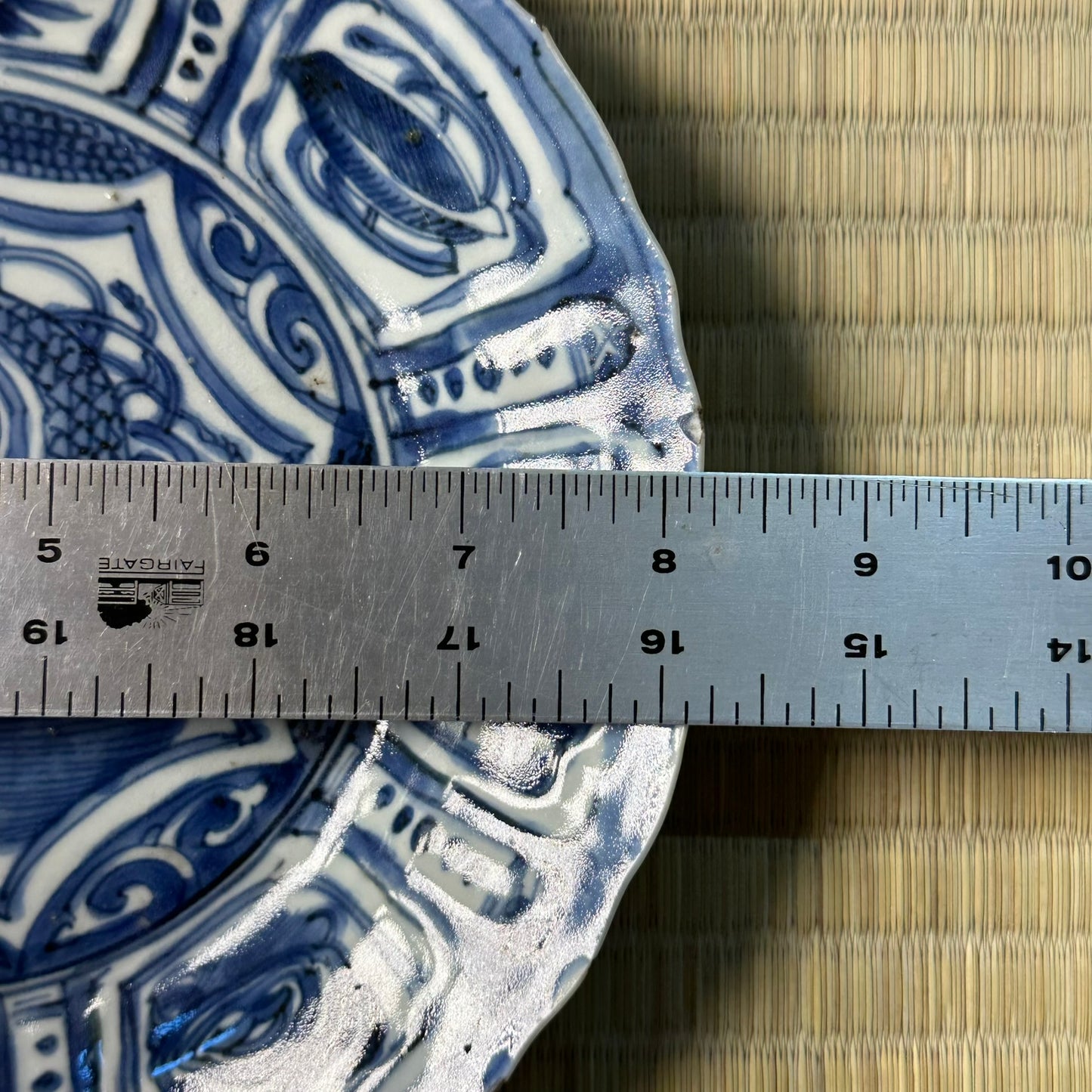
A Chinese qinghua (青花) blue and white porcelain plate in the kraak style of the Wanli period — the format that defined Chinese export porcelain for the global market from the late sixteenth century onward and that became the single most influential decorative template in the history of East Asian ceramics. The face presents a central octagonal medallion enclosing a covered vessel or scholar's object in cobalt blue, surrounded by a dense field of scrolling wave or cloud forms; the broad rim is organized into alternating radiating cartouches containing figural vignettes and geometric or foliate reserves, separated by narrow vertical dividers — the classic kraak compositional grammar in its original Chinese form. The reverse carries the standard Wanli kraak border of alternating octagonal-reserve and bar elements. The foot ring is wide, rough, and shows age-consistent wear and kiln grit. The cobalt is the characteristic Wanli blue — somewhat muted and grey-toned in the lighter passages, deepening to near-black in the heaviest brush areas.
Kraak porcelain — named by the Dutch for the Portuguese carracks that carried it to Europe — was produced at Jingdezhen during the Wanli reign (1573–1620) in enormous quantities for export to Europe, the Middle East, Southeast Asia, and Japan, where it was collected, imitated, and deeply influential on local ceramic traditions. The collapse of the Ming dynasty in 1644 interrupted this supply, driving European and Japanese buyers to seek alternatives — but the original Wanli kraak plates that reached those markets before 1644 are the source from which all subsequent imitation derived. At 8.25″ diameter this plate represents the smaller end of the kraak format. The loose, somewhat abbreviated brushwork and the honest kiln character of the foot ring are consistent with authentic Wanli export production rather than later imitation.
- Form: Qinghua porcelain plate, flat well, lobed/scalloped rim
- Decoration: Kraak-style — central octagonal medallion with covered vessel motif; radiating alternating figural and geometric cartouche border; standard Wanli kraak reverse border
- Mark: None — wide unglazed foot ring with kiln wear consistent with Wanli export production
- Period: Wanli period or later Ming dynasty, c. 1573–1644; attributed by Peter Combs
- Dimensions: 8.25″W (21 cm)
- Condition: Fritted and worn rim consistent with age and period handling; foot ring shows kiln grit and age wear; surface wear throughout; no confirmed cracks or repairs visible. Displays well. Please see photos for details.