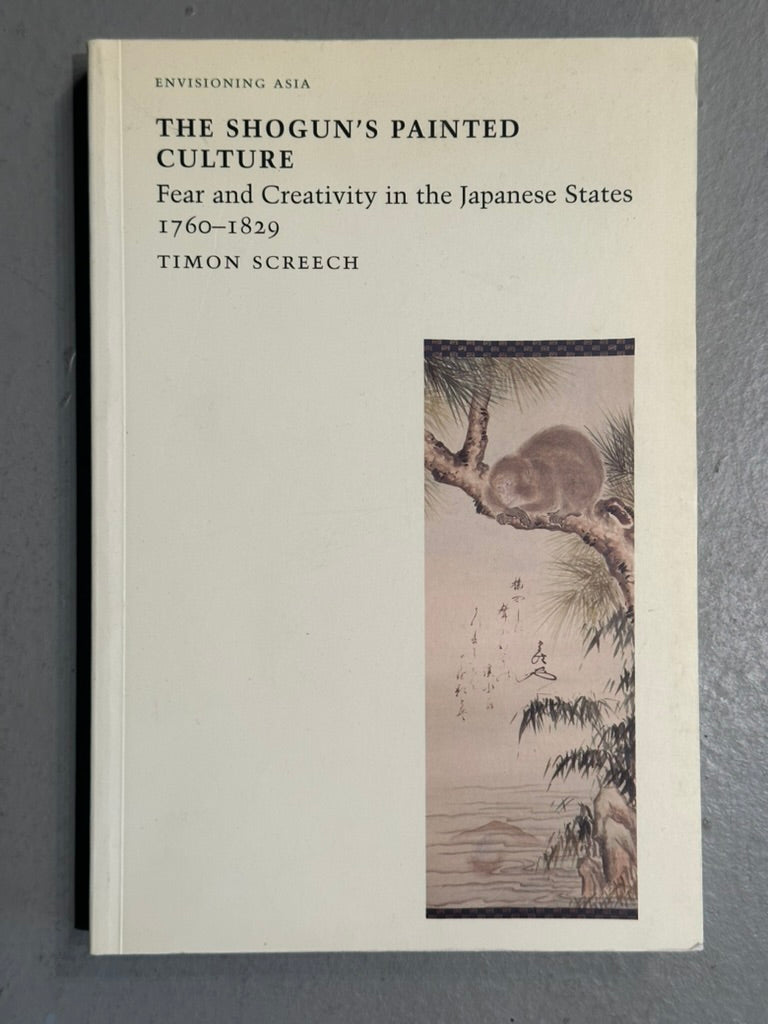

Shogun's Painted Culture: Fear & Creativity in the Japanese States, 1760–1829 by Screech 2000
Shogun's Painted Culture: Fear & Creativity in the Japanese States, 1760–1829 by Screech 2000
Couldn't load pickup availability
A penetrating cultural history of Japanese painting in the late Edo period, centered on the figure of Matsudaira Sadanobu (1758–1829), chief shogunal councillor and cultural arbiter who played a decisive role in shaping what we now think of as traditional Japanese visual culture. Screech examines how Sadanobu mobilized painting as a political instrument, promoting established academic styles and sponsoring the revival of historical and literary painting as a counterweight to the ukiyo-e tradition he opposed. The reconstruction of Kyoto after the great fire of 1788 provided the occasion for a sweeping reassertion of the shogunate's visual authority. Learned, readable, and richly illustrated, this is an essential text in the cultural history of Edo-period Japan.
- Title: The Shogun's Painted Culture
- Subtitle: Fear and Creativity in the Japanese States, 1760–1829
- Author: Timon Screech
- Publisher: Reaktion Books, London
- Publication Date: 2000
- Edition: First Edition
- Printing:
- Format: Softcover
- Pages: 312
- Illustrations: 111 illustrations, 20 in color
- ISBN-13: 978-1861890641
- Language: English
- Dimensions: 9 × 6 in.
- Series: Envisioning Asia
- Condition: Very Good
- Notes: Timon Screech is Senior Lecturer in the history of Japanese art at SOAS, University of London. Cover features a hanging scroll detail: a small animal (likely a rat) on a pine branch with calligraphy inscription.
- Description: A penetrating cultural history of Japanese painting in the late Edo period, centered on the figure of Matsudaira Sadanobu (1758–1829), chief shogunal councillor and cultural arbiter who played a decisive role in shaping what we now think of as traditional Japanese visual culture. Screech examines how Sadanobu mobilized painting as a political instrument, promoting established academic styles and sponsoring the revival of historical and literary painting as a counterweight to the ukiyo-e tradition he opposed. The reconstruction of Kyoto after the great fire of 1788 provided the occasion for a sweeping reassertion of the shogunate's visual authority. Learned, readable, and richly illustrated, this is an essential text in the cultural history of Edo-period Japan.