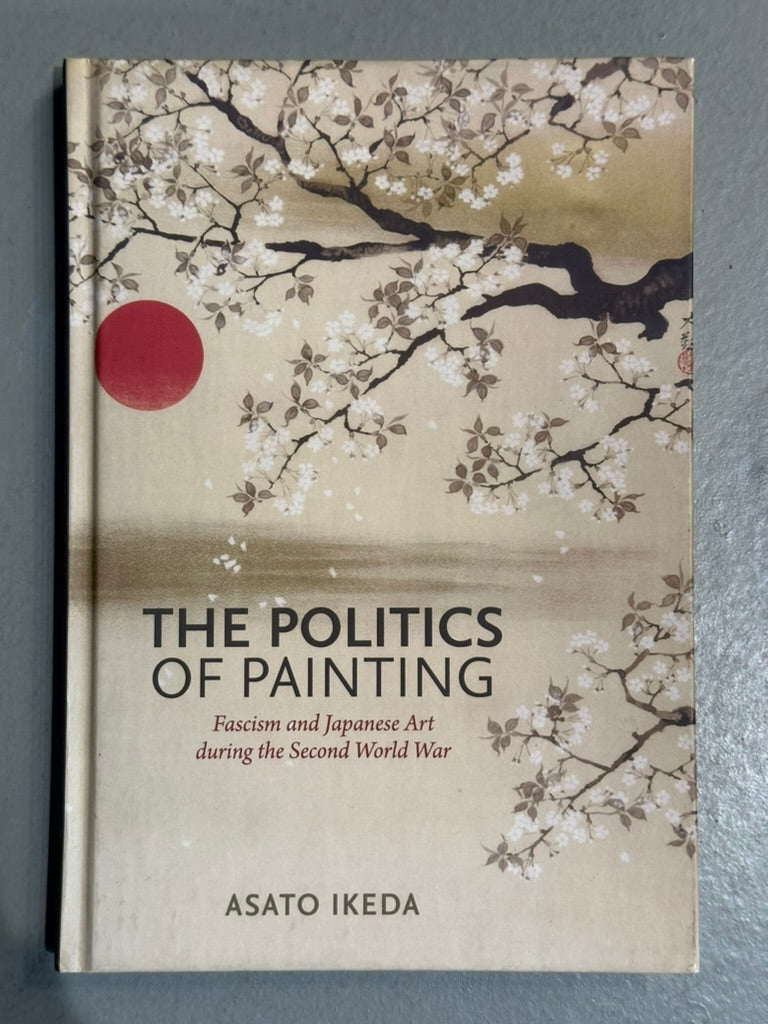

The Politics of Painting: Fascism & Japanese Art during the Second World War by A. Ikeda
The Politics of Painting: Fascism & Japanese Art during the Second World War by A. Ikeda
Couldn't load pickup availability
An incisive study of non-battle paintings produced in Japan during the 1930s and early 1940s that have received scant scholarly attention relative to more overtly militarist imagery. Ikeda examines the work of four prominent artists — Yokoyama Taikan, Yasuda Yukihiko, Uemura Shōen, and Fujita Tsuguharu — through the framework of Japanese fascism, demonstrating how their seemingly traditional paintings of Mount Fuji, historical samurai, beautiful women, and rural landscapes functioned to reinforce state ideology and justify imperial violence by asserting the cultural authenticity of Japan's wartime political order. The book challenges the postwar tendency to treat only explicit battle paintings as politically compromised, opening a broader comparative dialogue with art produced under Nazi Germany and Fascist Italy in the same period.
- Title: The Politics of Painting
- Subtitle: Fascism and Japanese Art during the Second World War
- Author: Asato Ikeda
- Publisher: University of Hawai'i Press, Honolulu
- Publication Date: 2018
- Edition: First Edition
- Printing:
- Format: Hardcover
- Pages: 144
- Illustrations: 33 color; 12 black-and-white
- ISBN-13: 978-0824872120
- Language: English
- Dimensions: 10.25 × 7.25 in.
- Series:
- Condition: Very Good
- Notes: Asato Ikeda is Assistant Professor, Department of Art History, Fordham University.
- Contents:
- Description: An incisive study of non-battle paintings produced in Japan during the 1930s and early 1940s that have received scant scholarly attention relative to more overtly militarist imagery. Ikeda examines the work of four prominent artists — Yokoyama Taikan, Yasuda Yukihiko, Uemura Shōen, and Fujita Tsuguharu — through the framework of Japanese fascism, demonstrating how their seemingly traditional paintings of Mount Fuji, historical samurai, beautiful women, and rural landscapes functioned to reinforce state ideology and justify imperial violence by asserting the cultural authenticity of Japan's wartime political order. The book challenges the postwar tendency to treat only explicit battle paintings as politically compromised, opening a broader comparative dialogue with art produced under Nazi Germany and Fascist Italy in the same period.