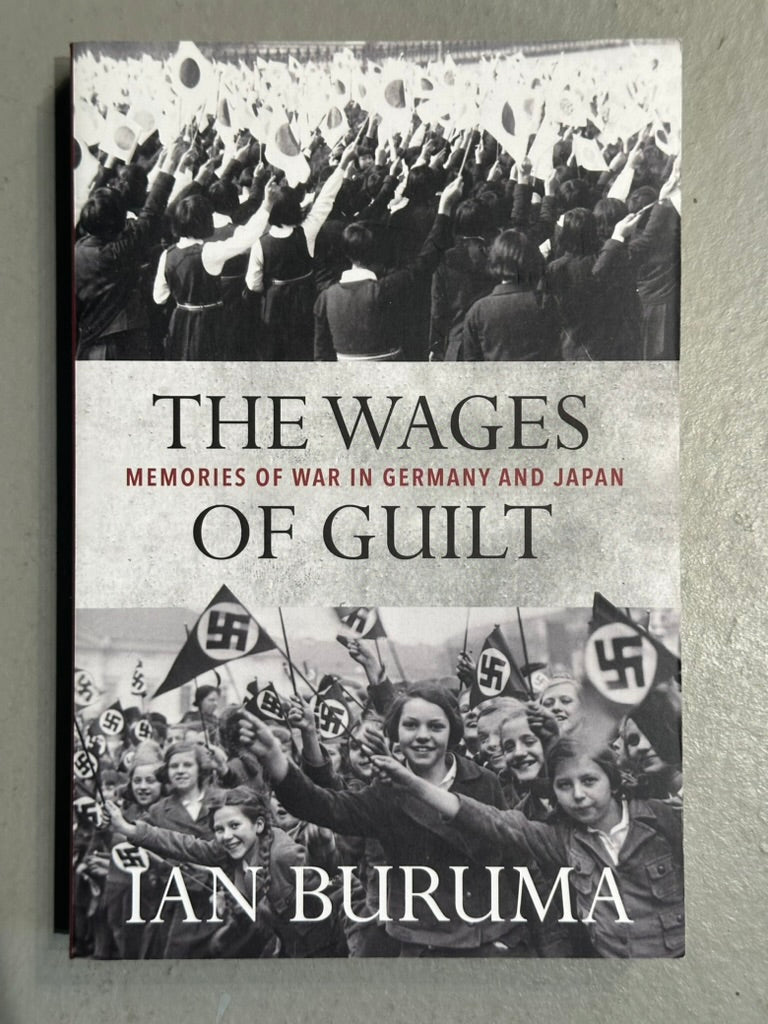

The Wages of Guilt: Memories of War in Germany and Japan by Ian Buruma 1994
The Wages of Guilt: Memories of War in Germany and Japan by Ian Buruma 1994
Couldn't load pickup availability
A landmark work of comparative cultural history examining how Germany and Japan have each attempted to reckon with the conduct and legacy of World War II. Buruma travels through both countries — visiting Auschwitz, Berlin, Hiroshima, and Tokyo — and speaks with scholars, politicians, survivors, artists, and activists whose divergent confrontations with guilt, denial, and memory form the book's core. He contrasts the former East and West German approaches to the Holocaust with Japan's polarized debate between those who wish to forget and those who invoke Hiroshima and wartime atrocities as warnings against renewed militarism. First published in 1994 and still widely assigned in university courses on modern Japan and postwar memory.
- Title: The Wages of Guilt
- Subtitle: Memories of War in Germany and Japan
- Author: Ian Buruma
- Publisher: New York Review Books, New York (current edition); originally Farrar, Straus and Giroux, 1994
- Publication Date: 1994; NYRB reprint 2015
- Edition:
- Printing:
- Format: Softcover (this edition)
- Pages: 330
- Illustrations:
- ISBN-13: 978-1590178584 (NYRB ed.)
- Language: English
- Dimensions:
- Series:
- Condition: Very Good
- Notes: Confirm edition from copyright page; cover matches NYRB reprint with black-and-white archival photographs. Ian Buruma is the Henry R. Luce Professor of Human Rights and Journalism at Bard College.
- Description: A landmark work of comparative cultural history examining how Germany and Japan have each attempted to reckon with the conduct and legacy of World War II. Buruma travels through both countries — visiting Auschwitz, Berlin, Hiroshima, and Tokyo — and speaks with scholars, politicians, survivors, artists, and activists whose divergent confrontations with guilt, denial, and memory form the book's core. He contrasts the former East and West German approaches to the Holocaust with Japan's polarized debate between those who wish to forget and those who invoke Hiroshima and wartime atrocities as warnings against renewed militarism. First published in 1994 and still widely assigned in university courses on modern Japan and postwar memory.