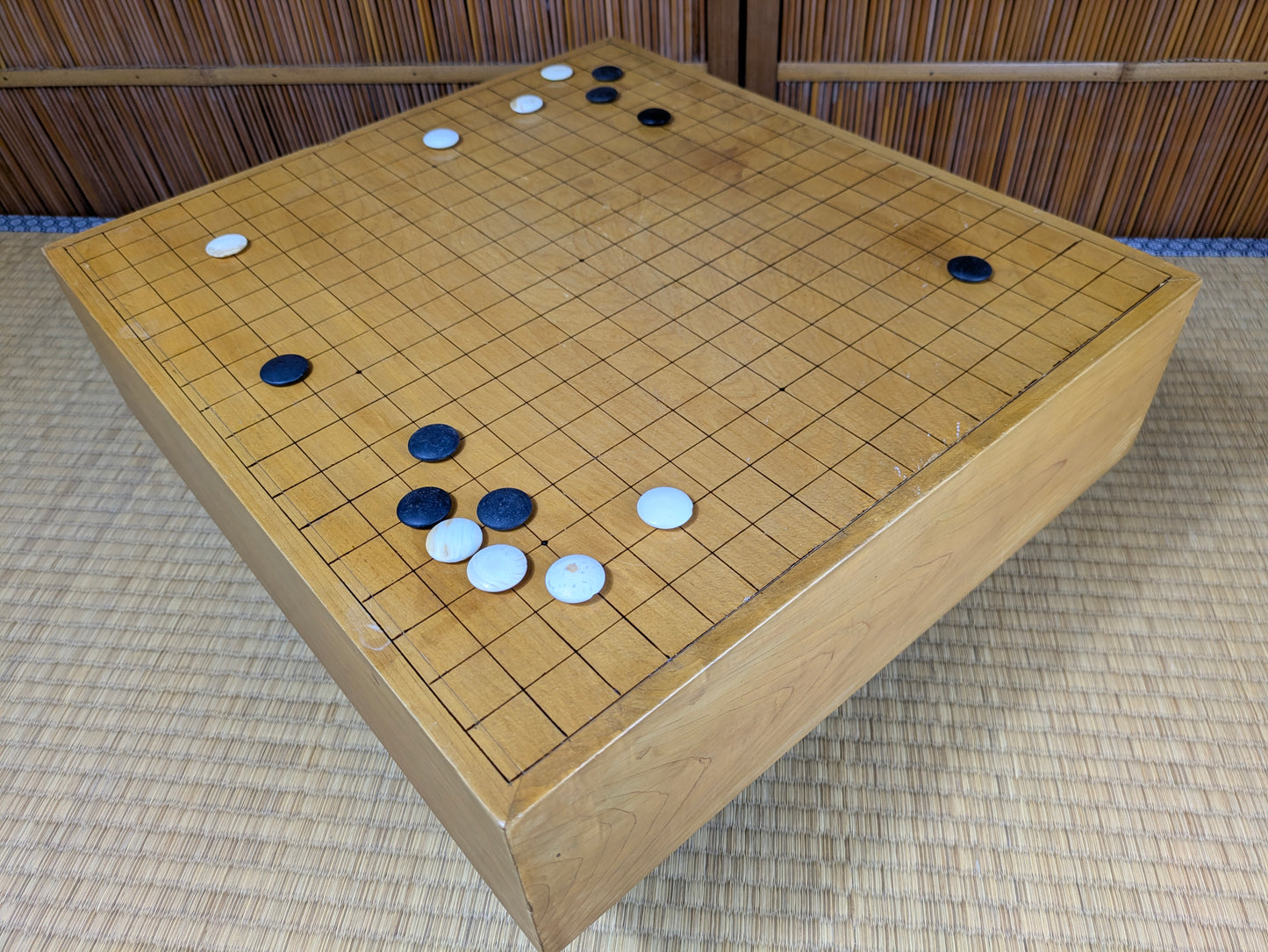


Vintage Japanese Kaya-Clad (11.5cm) Floor Go Board – 4-Sun Class, Late Showa–Early Heisei Era I9
Vintage Japanese Kaya-Clad (11.5cm) Floor Go Board – 4-Sun Class, Late Showa–Early Heisei Era I9
Couldn't load pickup availability
Vintage Japanese " thick Goban for the game of Go.
Vintage Japanese Kaya-Clad Floor Go Board – 4-Sun Class, Late Showa–Early Heisei Era
This is a classic Japanese floor goban crafted in the traditional hari-ban style, with an outer layer of genuine kaya (榧) applied over a solid domestic core. Boards of this type were produced in Japan during the late Showa to early Heisei period, when solid old-growth kaya became rare and expensive. The result is a board that retains the golden color, fragrance, and fine grain of kaya while offering long-term durability at a more accessible price.
The kaya veneer on the top and sides displays the tight grain and warm tone characteristic of seasoned kaya. When stones are placed, the 4-sun class thickness gives a satisfying, resonant sound. The core wood is visible on the underside—a typical multi-piece domestic softwood construction used by Japanese workshops during this period.
The board shows honest wear from decades of use, including surface scratches, edge rubbing, and light fading near the corners, but the grid remains clear and the structure is solid with no cracks. The traditional turned legs are original and securely attached.
A handsome, well-preserved vintage board ideal for players who want the beauty and feel of kaya without the cost of a full-block kaya goban. Excellent for everyday play, display, or as part of a collection of traditional Japanese equipment.
Measurements:
• Width: 42 cm
• Depth: 46 cm
• Block Thickness (T): 11.5 cm (4-sun class)
• Total Height (H): 22 cm
Era: Late Showa–Early Heisei (approx. 1975–1995)
Construction: Kaya veneer over composite core (hari-ban)
Wood (surface): Genuine kaya (Torreya nucifera)
Wood (core): Domestic softwood composite (sugi/kiri/katsura mix typical of the era)
Playing Go on a real Japanese floor board is a different experience from using a thin tabletop board. The thick wooden block produces a deeper, clearer click when stones are placed, a sound that the Nihon Ki-in has long described as part of the “proper atmosphere” of serious play. This resonance comes from both the thickness of the block and the type of wood used. Traditional makers favor kaya, a smooth, golden wood whose density and aging characteristics create a uniquely satisfying tone, but players also commonly encounter katsura, which is heavier and darker, and shin-kaya, a lighter spruce used in modern, affordable boards.
What sets Japanese floor boards apart is the way they’re built. The block rests on four legs, raising the board so that the wood can vibrate freely, and the underside is shaped so the sound of each stone remains consistent. The grain of the wood is chosen so the surface stays stable over time and retains its natural beauty. Even a mid-range Japanese board feels solid, balanced, and responsive under the hand. For players who haven’t used one before, the difference is immediate: the board feels alive, the stones settle cleanly, and the game gains a sense of weight and presence that’s hard to forget.
Length =
Width =
Thick =
Overall hight=