

Vintage Japanese Silk Kimono Allover Garden Landscape Teien Crane Pine Teal Showa
Vintage Japanese Silk Kimono Allover Garden Landscape Teien Crane Pine Teal Showa
Couldn't load pickup availability
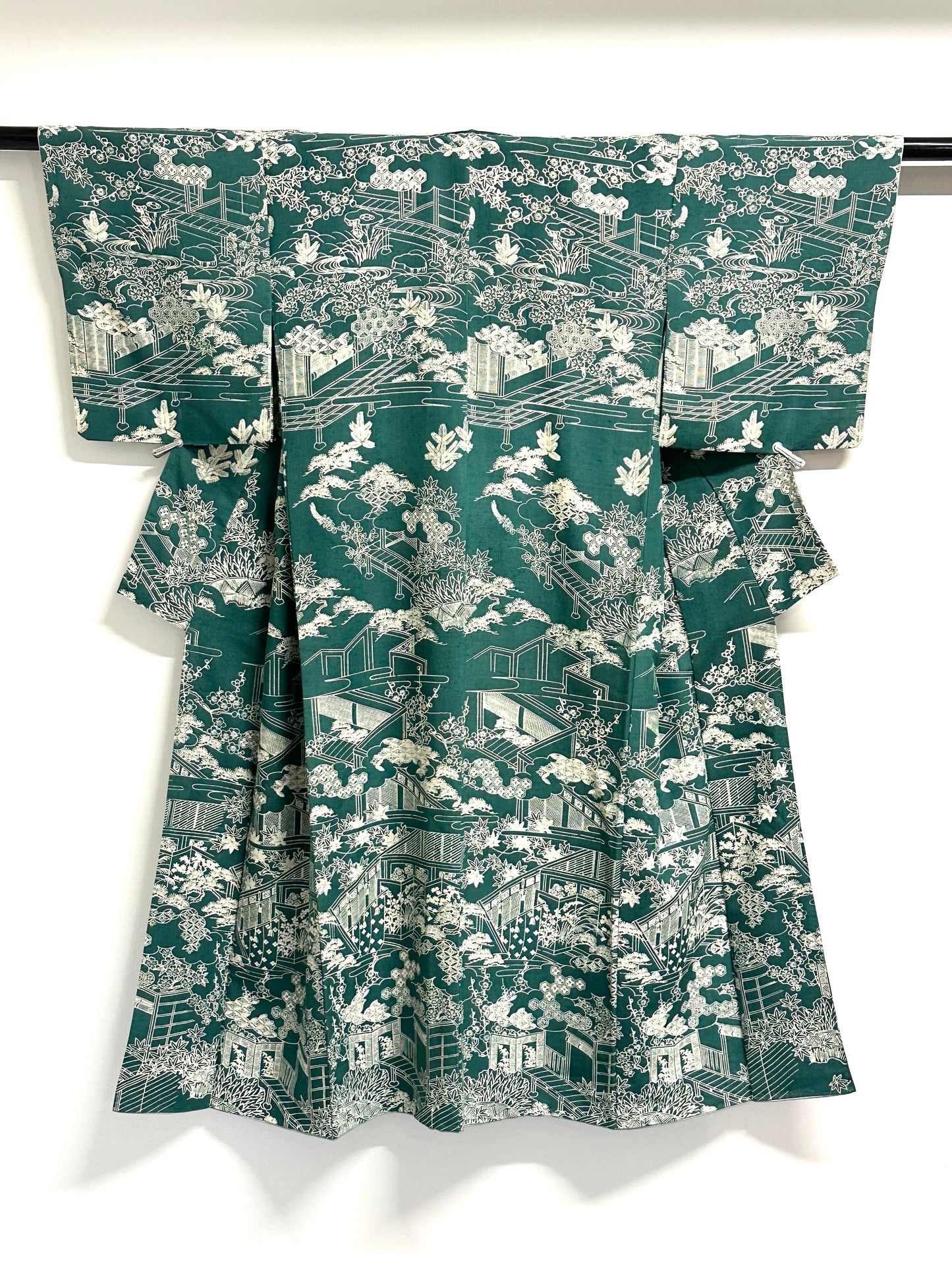
Vintage Japanese silk kimono, allover teien garden landscape with crane, pine, bridge, plum and stream in white on deep teal ground, grey-blue hakkake lining, Showa era
Japan; Showa era, mid-20th century, c. 1950s–1970s
A visually abundant vintage Japanese silk kimono in deep teal-green (緑青色, rokushō-iro), the entire surface covered in a continuous allover teien-zu (庭園図) garden landscape composition rendered in white and soft silver-grey resist dyeing against the rich ground. The decoration is not a repeat pattern but a flowing narrative field: arched stone garden bridges (taiko-bashi, 太鼓橋) span a winding stream whose surface is marked by the classic nagare (流れ) current-line; wooden garden fences and railings establish spatial recessions; twisted pine trees (matsu, 松) with characteristic cloud-pruned canopies anchor several compositions; flowering ume (梅, plum) branches scatter blossoms across the upper field; momiji (紅葉, autumn maple) leaves drift through the air; egrets or cranes stand and fly at the waterside; iris and waterside grasses grow at the stream banks; and chrysanthemum clusters fill the ground between the larger elements. The composition draws on the meisho-e (名所絵) tradition of famous landscape painting while condensing the auspicious motifs of all four seasons into a single idealized garden — a convention of classical Japanese decorative arts expressing the wish for perpetual beauty and fortune. The technique throughout is kata-yuzen (型友禅) stencil dyeing in white resist, the crisp outlines and flat tonal passages characteristic of well-executed Showa-era stencil production. The lining is cream-ivory silk in the upper body with a soft grey-blue hakkake (八掛) hem lining.
The teien (庭園, Japanese garden) as a decorative subject for kimono carries associations with cultivated taste, seasonal awareness, and the philosophical aesthetics of the garden tradition — a subject that connects the wearer simultaneously to classical painting, garden design, and the literature of mono no aware (物の哀れ, the pathos of things). The combination of this subject with a deep teal ground gives the garment considerable visual strength while remaining within the bounds of refined semi-formal elegance.
- Fabric: Silk, smooth (chirimen crepe or habutae)
- Decoration: Allover zenmen teien-zu (庭園図) garden landscape in white kata-yuzen resist: taiko-bashi bridge, garden fencing, matsu pine, nagare stream, ume plum, momiji maple, egrets/cranes, iris, chrysanthemum; continuous narrative composition on deep teal-green ground
- Lining: Cream-ivory silk upper body; soft grey-blue hakkake (八掛) hem lining
- Period: Showa era, mid-20th century, c. 1950s–1970s