

Vintage Japanese Silk Kimono Kiku Hanazume Suso on Deep Green Gold Bokashi Showa
Vintage Japanese Silk Kimono Kiku Hanazume Suso on Deep Green Gold Bokashi Showa
Couldn't load pickup availability
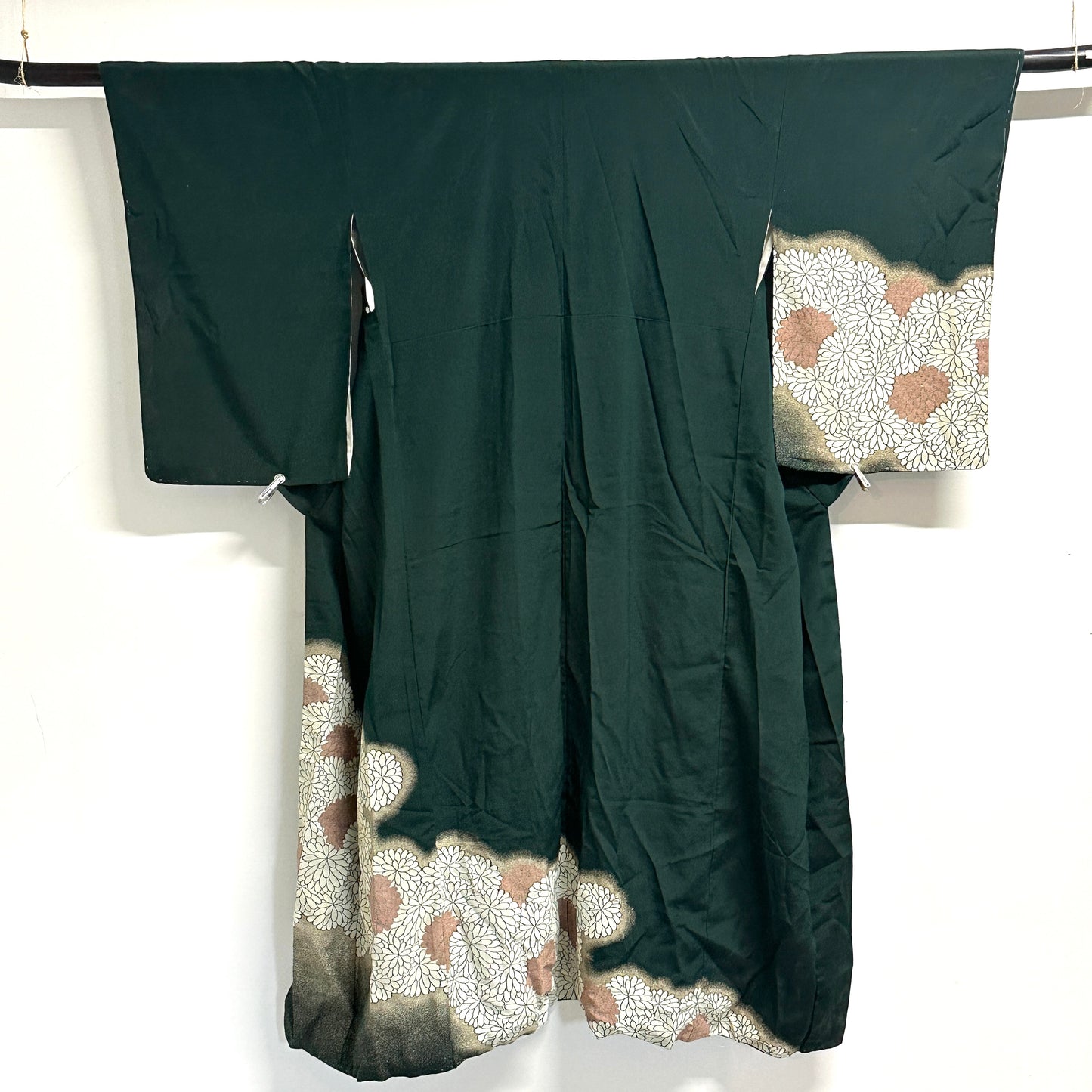
Vintage Japanese silk hōmongi kimono, kiku hanazume chrysanthemum suso-moyō with gold bokashi gradation on deep forest green ground, Showa era
Japan; Showa era, mid-20th century, c. 1950s–1970s
A kimono of commanding formal presence: a deep forest green (深緑, fuka-midori) silk ground of smooth habutae with a high, jewel-like satin sheen, the vast unadorned expanse of the body allowing the decoration at hem and sleeve cuffs to register with maximum visual impact. The suso-moyō composition begins at the very hem edge with a dense gold metallic bokashi (暈し) gradation — a zone of warm gold-silver surihaku speckle that evokes ground fog or moonlit mist — rising into the kiku hanazume (花詰) field above. Within this field, kiku (菊, chrysanthemum) blossoms are packed densely in the hanazume manner: cream-white blossoms with fine black petal-outline detail fill the ground completely, their tightly spiraling petals carrying a slight dimensional quality consistent with embroidery or shibori-resist work. Set among and behind the cream kiku, larger circular chrysanthemum forms in dusty rose-pink provide a second color register, their softer, fuller petals contrasting with the tightly rendered cream blossoms to create layered depth within the composition. The same decoration appears at both sleeve cuffs in the hōmongi placement convention, completing the garment's formal grammar. The lining is plain white-cream silk in the upper body with a deep green hakkake hem lining — an interior that sustains rather than interrupts the exterior's mood.
The kiku hanazume convention — packing the entire decorative field with chrysanthemum heads without open ground — is among the most formally charged ornamental strategies in Japanese textile production, associated with auspicious fullness, longevity, and imperial dignity. The combination here with the gold bokashi gradation and the severity of the deep green ground achieves a particularly refined version of this convention: not opulent in the Edo sense, but concentrated and assured in the manner of mature Showa formal taste.
- Fabric: Silk, smooth habutae or satin-weave, deep forest green (深緑, fuka-midori)
- Decoration: Suso-moyō and sleeve cuff (hōmongi placement): kiku hanazume packed chrysanthemum in cream-white with black outline and dusty rose, over gold-silver surihaku bokashi gradation at hem; cream kiku with possible embroidery or shibori-resist dimensional detail
- Lining: Plain white-cream silk upper body; deep green hakkake (八掛) hem lining
- Period: Showa era, mid-20th century, c. 1950s–1970s