

Vintage Japanese Silk Kimono Scattered White Botanical Chirashi Celadon Showa
Vintage Japanese Silk Kimono Scattered White Botanical Chirashi Celadon Showa
Couldn't load pickup availability
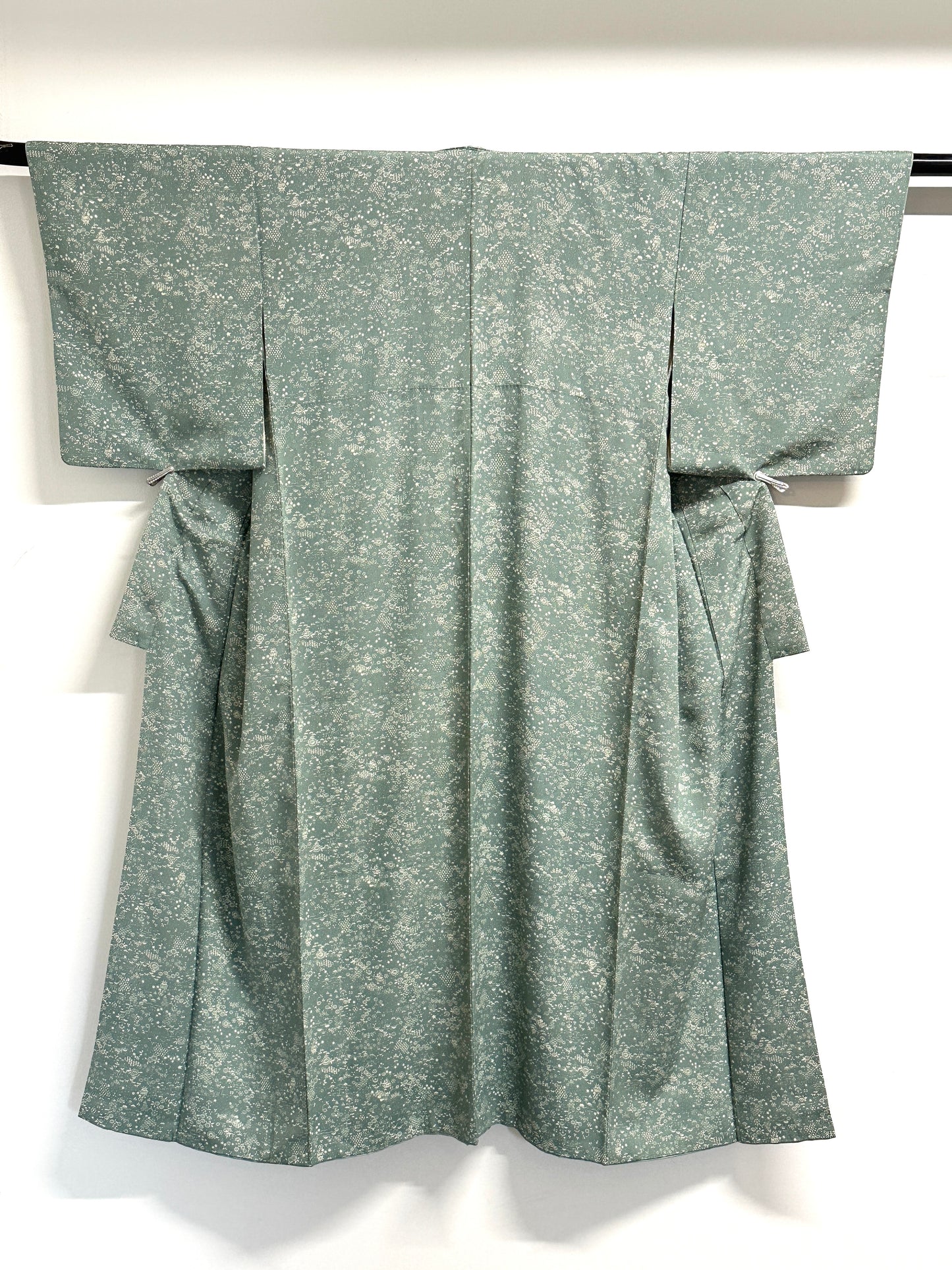
Vintage Japanese silk kimono, allover chirashi scattered white botanical micro-motif on celadon grey-green ground, grey-blue hakkake lining, Showa era
Japan; Showa era, mid-20th century, c. 1950s–1970s
A kimono of quiet, considered beauty, the ground a smooth celadon grey-green silk (青磁色, seiji-iro) with a fine diagonal twill weave that gives the fabric a subtle directional sheen. The entire surface is worked in the chirashi (散らし, scatter) tradition: an allover free distribution of tiny white botanical micro-motifs — flowering sprigs, small leaf clusters, individual blossoms, circular rosette forms, and scattered small figures that may include birds or insects — rendered in flat white resist against the green-grey ground. Unlike a mechanical komon repeat, the scatter has an organic, improvisational quality: the motifs drift and cluster freely, denser in some areas and more open in others, creating the atmospheric impression of a garden seen through morning mist or a meadow dusted with small wildflowers. At normal viewing distance the garment reads as a finely textured celadon field; approached closely, it resolves into a world of miniature botanical detail. The lining is plain white silk in the upper body with a soft grey-blue hakkake (八掛) hem lining — a color choice that harmonizes with rather than contrasts the exterior ground, sustaining the garment's overall mood of restrained, tonal refinement.
The chirashi convention — scattering motifs freely across a ground rather than organizing them into borders, bands, or pictorial compositions — has deep roots in both Japanese painting and textile production, where it carries associations with natural abundance, seasonal transience, and the aesthetic value of incompleteness. A chirashi-composition kimono in a muted, harmonious palette occupies the register of restrained sophistication: appropriate for tea ceremony attendance, cultural gatherings, and occasions where understatement is the more articulate statement.
- Fabric: Silk, fine diagonal twill weave
- Decoration: Allover chirashi (散らし) scattered white botanical micro-motifs — flowering sprigs, leaf clusters, blossoms, rosettes, small figures — on celadon grey-green (青磁色, seiji-iro) ground
- Lining: Plain white silk upper body; soft grey-blue hakkake (八掛) hem lining
- Period: Showa era, mid-20th century, c. 1950s–1970s