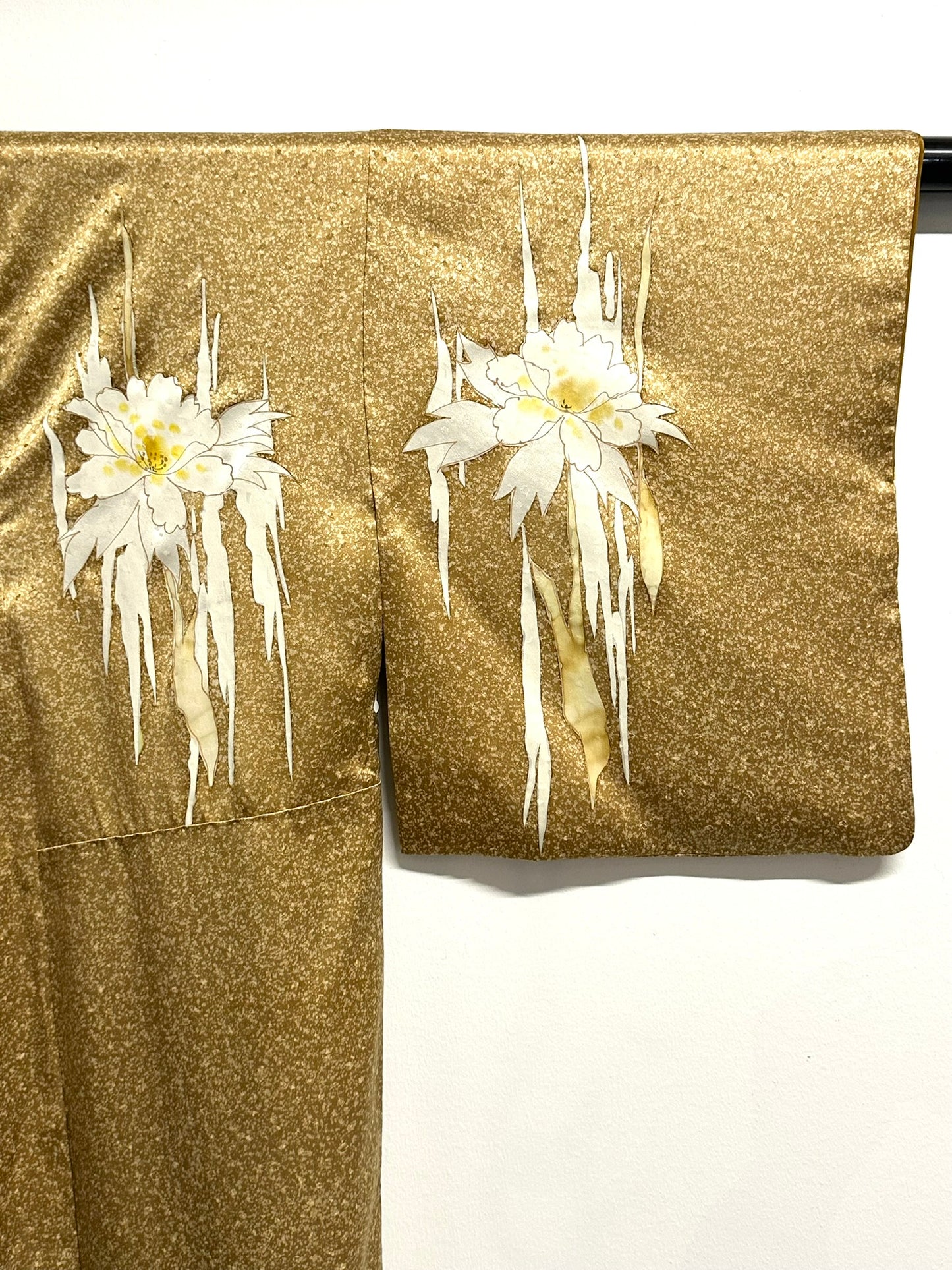


Vintage Japanese Silk Nashiji Gold Kimono Yuzen Suisen Narcissus Showa Era
Vintage Japanese Silk Nashiji Gold Kimono Yuzen Suisen Narcissus Showa Era
Couldn't load pickup availability
Vintage Japanese silk kimono, yuzen suisen narcissus on allover nashiji gold speckle ground with surihaku metallic accents, gold hakkake lining, Showa era
Japan; Showa era, mid-20th century, c. 1950s–1970s
A kimono of exceptional material richness, the ground silk worked throughout in the nashiji (梨子地, "pear-skin") manner — an allover field of fine gold and ivory flecks distributed across the surface to evoke the speckled texture of a pear's skin, achieved through surihaku (摺箔) gold-foil application or a closely related metallic technique. The effect across the full garment is of burnished antique gold, the surface shifting between matte and lustrous as the light moves — a quality that plain-dyed silk cannot replicate and that places this piece in the tradition of the most elaborate Showa formal textile production.
Against this shimmering ground, the decoration is deliberately spare: clusters of suisen (水仙, narcissus/daffodil) rendered in white and cream with long, sharply tapering strap-like petals fanning outward from cupped cream-gold centers, accompanied by the characteristic long blade-like leaves of the plant and slender pendant buds on arching stems. The forms are outlined and detailed in the yuzen (友禅) tradition with fine resist lines and gold surihaku accents within the petals, the gold of the decoration echoing and enriching the gold of the ground in a dialogue of metallic tones. The composition is placed freely across the garment — sleeve cuffs, lower body, and scattered intermediate positions — with each cluster standing in open ground without crowding, allowing the nashiji surface full expression between the motifs. The lining is plain white silk in the upper body with a warm gold-orange hakkake (八掛) hem lining.
Suisen (水仙, literally "water hermit") — the narcissus — is a classical winter and early spring motif in Japanese textile decoration, associated with purity, elegance, and the first warmth after cold. In the context of a nashiji-ground formal kimono, the pairing of the metallic ground with the spare white blossoms is a refined compositional choice: the restraint of the motif placement allows the extraordinary ground to register as the primary visual event, with the suisen providing graceful punctuation rather than competing for attention.
- Fabric: Silk with allover nashiji (梨子地) gold speckle ground, surihaku metallic technique
- Decoration: Free-composition yuzen suisen (水仙, narcissus) in white and cream with gold surihaku petal accents; long blade-like leaves and pendant buds
- Lining: Plain white silk upper body; gold-orange silk hakkake (八掛) hem lining
- Period: Showa era, mid-20th century, c. 1950s–1970s
- Dimensions:
- Condition: This is a vintage silk garment and may exhibit minor age-related characteristics such as slight discoloration, faint spotting, or occasional pulled threads consistent with its age and prior wear. Please see photos for details and feel free to contact us with any questions prior to purchase.